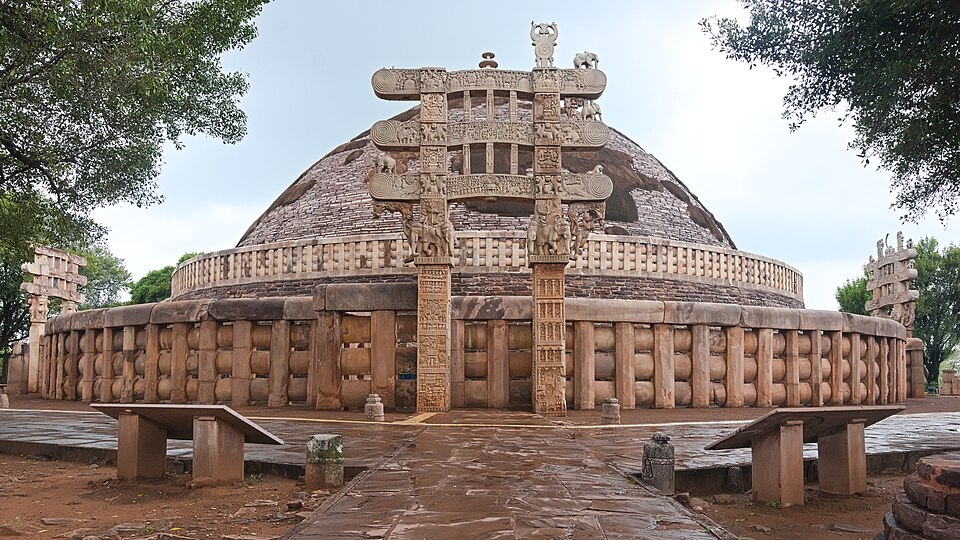
The Great Stupa at Sanchi does not invite the visitor into a large decorated interior. Much of the experience takes place outside, along a route and beside carved gateways. This can surprise anyone expecting every sacred monument to work like a hall. Understanding that difference is the first step towards seeing the stupa on its own terms.
Start with the form
Sanchi’s Buddhist monuments developed over a long period. The mound-like stupa, enclosing railings and gateways belong to a history of patronage and additions rather than a single moment frozen in stone. Check the identification panels before assigning one date to every visible part.
Look at the path as carefully as the central form. A route around a sacred object gives movement a role in the experience. From a permitted viewpoint, notice how the monument changes as one gateway replaces another in your field of vision.
Give one gateway your attention
Instead of photographing all the carvings quickly, select a small section. Identify the boundaries of a scene, the direction of the figures and the relationship between human, animal and architectural forms. A guidebook or knowledgeable guide can help name the story once you have actually looked at it.
Some Buddhist narrative images use objects or signs where a modern viewer might expect a central human figure. Do not assume a scene is missing its subject simply because you cannot immediately recognise a portrait of the Buddha. Iconographic conventions require context.
Ask who made the monument possible
Large monuments depend on more than royal ambition. Questions about donors, craftspeople and religious communities open a wider history of how sacred places were sustained. Where an inscription is identified, use a reliable translation rather than guessing from the shape of the letters.
It is also worth asking what survives and what has been conserved. A carefully maintained site can look timeless, but preservation involves research and decisions. Learning about that work makes the current appearance more intelligible without diminishing the old stonework.
Carry the observation home
Write a short description before reading a detailed explanation: perhaps “three figures turn towards a tree within a railing.” Then compare it with the published interpretation. The exercise shows the difference between what you observed and what you learned from another source.
Follow restrictions around railings and carvings, and never touch a surface to make a motif clearer in a photograph. Sanchi offers enough to study from the visitor route. A patient encounter with one gateway can become a lasting introduction to Buddhist visual storytelling.
Sources & further reading
UNESCO World Heritage Centre — site history and significance