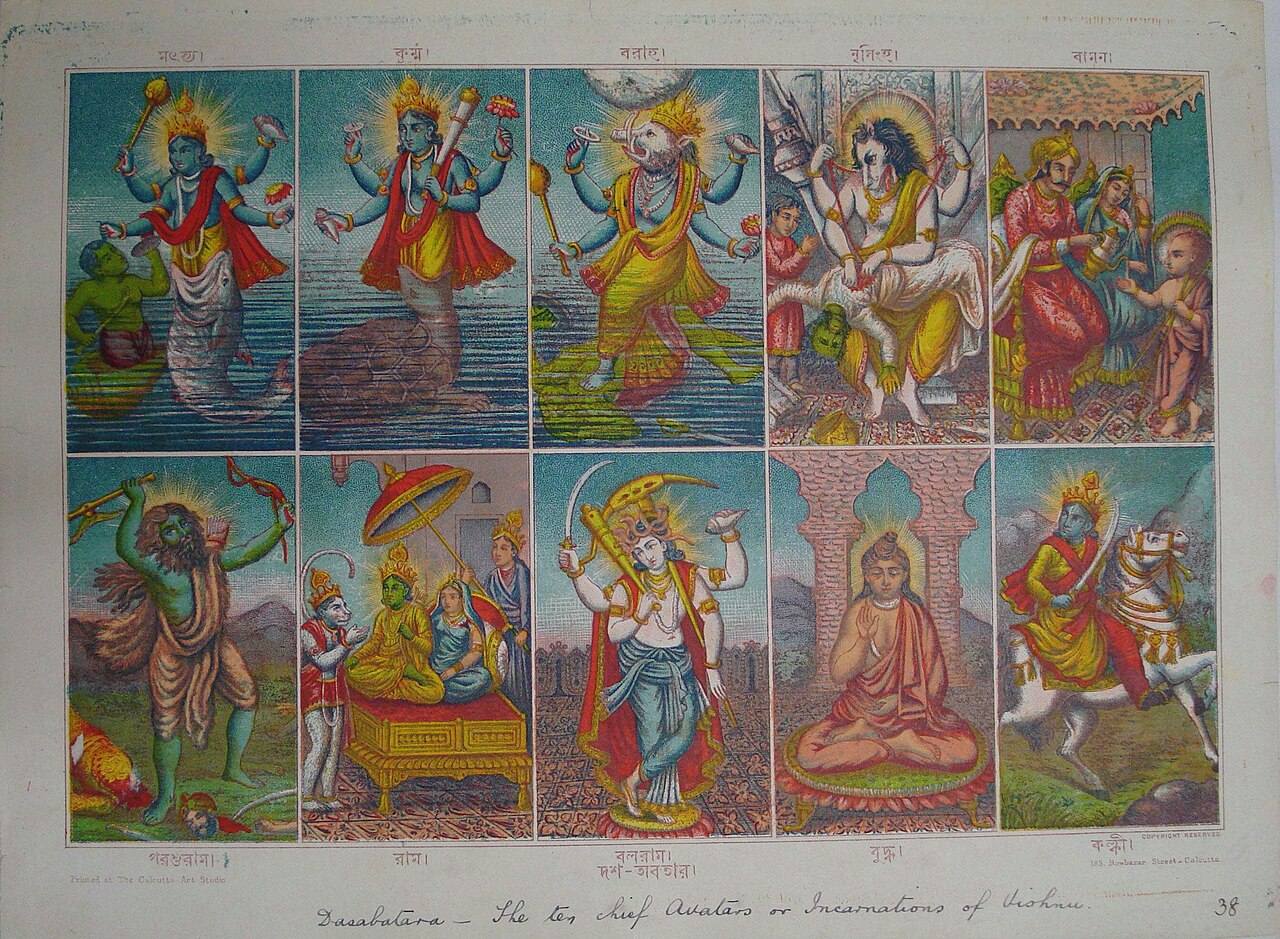

The Dashavatara brings together ten celebrated forms of Lord Vishnu. A fish, a tortoise, a lion-man, a young seeker and familiar epic figures appear in the same devotional sequence. Their stories ask different questions: what deserves protection, how power should be used, and what happens when pride overtakes responsibility.
This guide follows the widely used list of Matsya, Kurma, Varaha, Narasimha, Vamana, Parashurama, Rama, Krishna, Buddha and Kalki. Other traditions include Balarama. The differences are explained below so that a family prayer, a temple sculpture and a printed list can be read on their own terms.
The idea of divine manifestation
In the Bhagavad Gita, Krishna speaks to Arjuna about manifesting when dharma declines. These verses help explain the devotional understanding of an avatara; they do not themselves enumerate ten avatars.
यदा यदा हि धर्मस्य ग्लानिर्भवति भारत ।
अभ्युत्थानमधर्मस्य तदात्मानं सृजाम्यहम् ॥ ४-७॥
Bhagavad Gita 4.7 — simple meaning: Whenever dharma declines and adharma rises, Krishna tells Arjuna that he manifests himself. Here, dharma concerns the order and responsibilities that sustain life; reducing it to a single English word misses some of its scope.
परित्राणाय साधूनां विनाशाय च दुष्कृताम् ।
धर्मसंस्थापनार्थाय सम्भवामि युगे युगे ॥ ४-८॥
Bhagavad Gita 4.8 — simple meaning: He manifests age after age to protect the good, bring wrongdoing to an end and re-establish dharma. This is an introductory paraphrase, not a replacement for reading the verse with a full commentary.
The Sanskrit is retained in Devanagari, with the explanatory English kept outside the verse. Read the Sanskrit text of chapter four.
1. Matsya — मत्स्य
Matsya is the fish form of Vishnu. In the Bhagavata account, King Satyavrata shelters a small fish that repeatedly outgrows its container. The growing fish is revealed as divine, and the narrative leads to a great flood, a boat and the preservation of life and sacred knowledge.
The small beginning matters. Care is offered before the king understands whom he is protecting. When reading or retelling the story, notice how that relationship changes: the protected creature becomes the protector. Paintings may show a fish alone or a human upper body rising from a fish form; both belong to its visual vocabulary.
2. Kurma — कूर्म
Kurma is the tortoise form associated with the churning of the ocean. Mount Mandara serves as the churning rod, while the serpent Vasuki becomes the rope. When the mountain needs support, Vishnu as Kurma bears it upon his back.
In a crowded painting of the ocean-churning scene, the tortoise may be easy to overlook beneath the mountain. Looking for it changes the way the scene is read: a spectacular effort depends on a steady foundation. That is a useful reflection on the image, rather than a claim that the narrative describes a physical experiment.
3. Varaha — वराह
Varaha, the boar form, raises the Earth from the waters. In familiar Puranic tellings, this rescue is connected with his battle against Hiranyaksha. Earth may be shown as the goddess Bhudevi, supported beside the boar-headed Lord.
Varaha sculpture rewards slow looking. Find the tusk, the position of Bhudevi and the surrounding figures before deciding what a particular work depicts. Some images are fully animal-shaped, while others combine a human body with a boar’s head. Their differences show how artists give shape to the same devotional theme of rescue and restoration.
4. Narasimha — नरसिंह
Narasimha is the man-lion form who protects Prahlada from his father Hiranyakashipu. The king’s attempts to secure himself against death meet a manifestation that crosses the categories on which his confidence depends. In the familiar account, the confrontation takes place at twilight and at a threshold.
Prahlada’s steadfast devotion is as central as the dramatic confrontation. A retelling that focuses only on the fierce image can miss the relationship between the devotee and the protector. Temple images also include peaceful forms of Narasimha, reminding visitors that a single episode does not exhaust the deity’s worship.
5. Vamana — वामन
Vamana approaches King Bali as a small Brahmin seeker and asks for land measured by three steps. After Bali agrees, the divine form expands to cosmic scale. The expansive form is known as Trivikrama, whose great stride becomes a distinctive subject in temple sculpture.
The story allows room to think about both generosity and possession. Bali is not merely a forgettable opponent: his promise and surrender give the encounter much of its emotional force. When comparing regional retellings, pay attention to how they portray him. A concise avatar list cannot capture every community’s affection for the king.
6. Parashurama — परशुराम
Parashurama is the axe-bearing figure associated with Jamadagni and Renuka. His stories address conflict with kings and the misuse of ruling power. He also appears across epic traditions, which makes him harder to place in a simple sequence of isolated lives.
The axe is a useful identifying feature in an image, but the narrative deserves more than a weapon label. Questions of anger, vengeance and restraint remain difficult within it. Read the episodes as part of their larger literary setting rather than turning a sacred battle account into a rule for treating people today.
7. Rama — राम
Rama is the prince of Ayodhya at the centre of the Ramayana tradition. Exile, Sita’s abduction, the search aided by Hanuman, and the conflict with Ravana form the outline many readers first encounter. A bow often helps identify Rama in visual art.
His story asks what duty costs when obligations pull in different directions. Reading a whole episode, including the words of Sita, Lakshmana or Bharata, offers more than extracting a single moral sentence. Regional Ramayanas and performance traditions also bring different emphases to familiar scenes; name the version when discussing a detail that varies.
8. Krishna — कृष्ण
Krishna appears as the beloved child of pastoral narratives, the flute-playing Lord of devotional poetry, and Arjuna’s charioteer and teacher in the Bhagavad Gita. These settings illuminate different relationships with the divine: affection, friendship, devotion and the search for understanding.
A flute identifies one familiar visual form, but not every Krishna image includes one. In a battlefield scene, look instead for Arjuna, the chariot and the conversation between them. Some Vaishnava traditions understand Krishna as the source of other manifestations, so the phrase “eighth avatar” is a convention of this list rather than a complete account of every school’s theology.
9. Buddha — बुद्ध
Buddha appears in a number of Hindu avatar lists and in Jayadeva’s devotional hymn. This inclusion belongs to a Hindu interpretation of the relationship between traditions. It should not be presented as the Buddhist understanding of the Buddha’s identity.
That distinction matters when writing captions or teaching children. One can explain an image’s place in a Dashavatara sequence while respecting Buddhism as a tradition with its own teachings and sources. Accounts of the Buddha in Puranic literature also need to be distinguished from a historical biography of Siddhartha Gautama.
10. Kalki — कल्कि
Kalki is the future manifestation associated with the end of Kali Yuga and the renewal of dharma. The horse and sword are familiar features of his representation. Unlike the earlier narrative episodes in this guide, this is a future-oriented sacred account.
It is helpful to keep that difference visible when arranging a family reading or a school display. A painted scene expresses the tradition’s expectation of renewal; it does not establish a modern calendar date. This guide makes no prediction about an imminent appearance or identification with a living person.
Why does another list include Balarama?
There is more than one received list of ten. Jayadeva’s Dashavatara hymn includes the plough-bearing form associated with Balarama as well as Buddha, while addressing Keshava throughout. The historical print at the top of this page likewise shows a plough-bearing figure in its lower row. Its artwork therefore differs from the Krishna-inclusive introductory list followed in the ten sections above.
The Bhagavata Purana’s first canto also describes more manifestations than ten. Dashavatara is a celebrated selection, not a claim that the divine can appear in only ten forms. When two lists differ, identify the text, region or devotional tradition behind each before calling one a mistake.
Reading the stories together
Begin with one story and one image. Ask who needs protection, what changes during the encounter, and which visual feature helps identify the form. Then read the relevant passage in a named text. Keep the original Sanskrit, its translation and your own reflection visibly separate.
The sequence is sometimes compared with the development of life from water to land and human society. Such comparisons are modern interpretations; this page treats the avatars as sacred narratives and does not present the sequence as a scientific theory of evolution.
Sources and further reading
- Bhagavad Gita, chapter 4, verses 7–8 — Sanskrit text
- Jayadeva’s Dashavatara hymn — Sanskrit text and the differing list
- Bhagavata Purana 1.3 — a broader catalogue of manifestations
- Bhagavata Purana 8.24 — Matsya
- Bhagavata Purana 8.7 — Kurma and the ocean churning
- Bhagavata Purana 7.8 — Narasimha and Prahlada