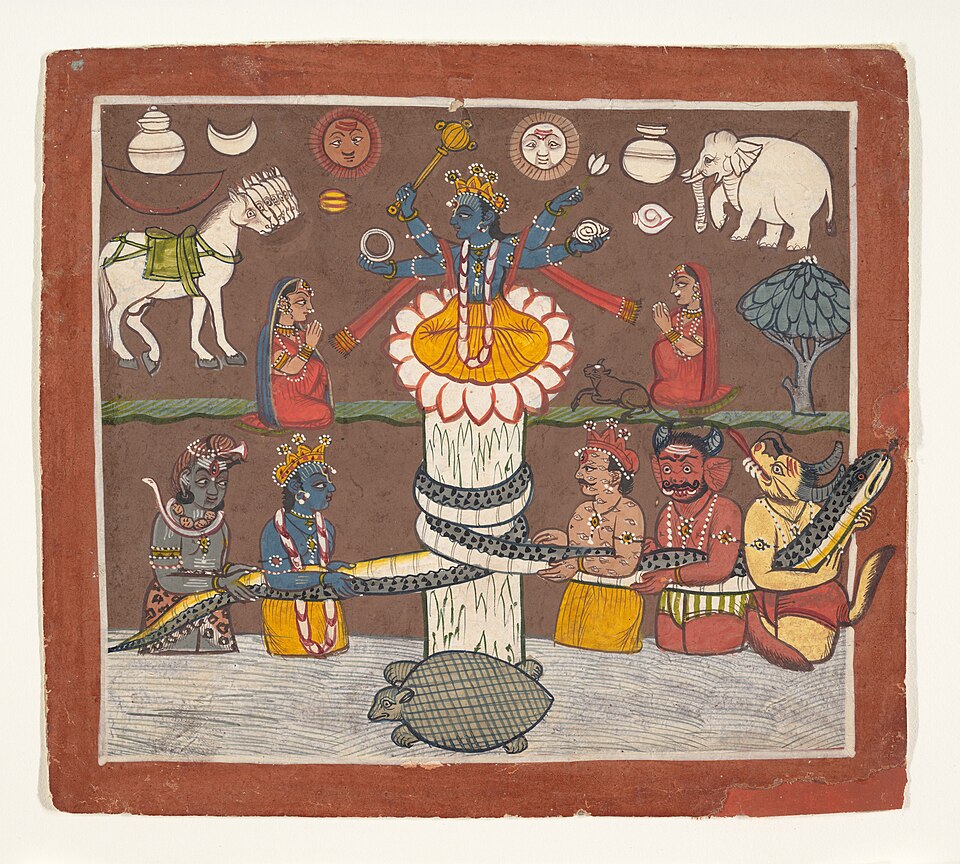
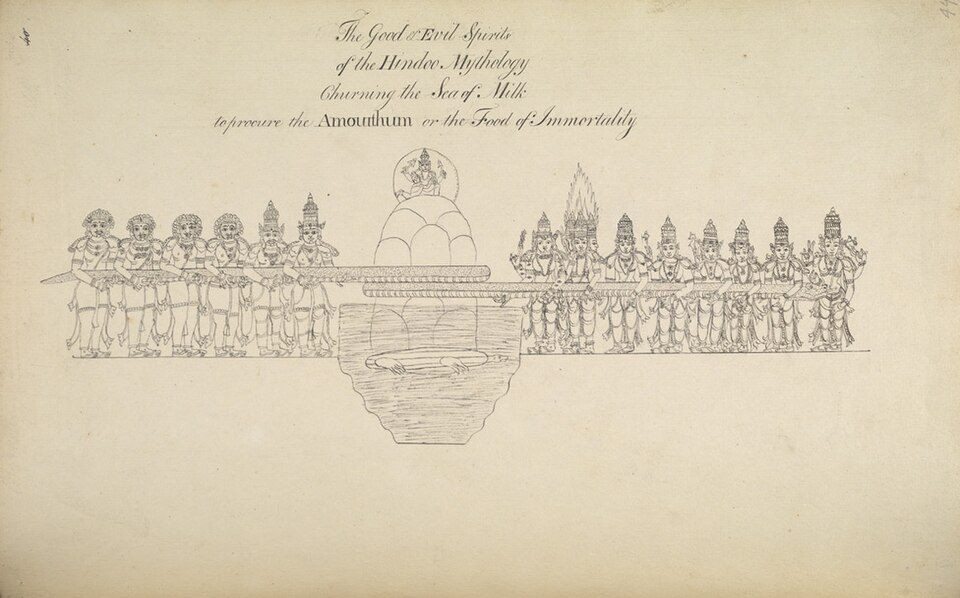
Samudra Manthan is a particularly rewarding story to study through images. A mountain becomes a churning rod, a serpent serves as a rope and Vishnu's tortoise form provides support. Paintings and reliefs arrange these elements differently, inviting the viewer to follow movement across a scene rather than search for a single central portrait.
Find the action first
Begin with the churning axis and the figures pulling on either side. Look for the serpent's body and the water around the mountain. Is the tortoise visible below, or has the artist placed the support outside the main scene? A small detail can carry a large part of the narrative.
Some works show several episodes together. A figure emerging from the water may belong to a different moment from the pulling teams beside it. This is a storytelling method, not a failure to depict one photographic instant. Reading an image from left to right will not always reveal its sequence.
Remember what the alliance seeks
In familiar retellings, devas and asuras cooperate to obtain amrita, the nectar of immortality. The undertaking brings dangers as well as desired treasures. Shiva's association with the poison and Vishnu's interventions are important to many accounts, but details and the enumeration of treasures differ among versions.
An image may emphasise cooperation, divine protection, rivalry or the distribution of the nectar. Before calling a detail an error, check the work's caption and the narrative tradition used by its artist. A temple relief and a later devotional print may be telling related stories for different audiences.
Interpretation is a second step
Readers sometimes interpret the ocean as the mind and the churning as inner work. That is a possible reflective reading, not proof that the story encodes modern psychotherapy or the exact stages of meditation. The earlier article made that equivalence too confidently and linked Shiva's action to a breathing lock; those assertions have been removed.
Keep two notes beside an image: what is shown and what you think it might mean. This small separation helps prevent an attractive interpretation from replacing the evidence in front of you.
Compare two representations
Choose works whose date, place and collection are known. Compare the scale of the mountain, the posture of the pullers and which events receive space. You do not need to settle the story's entire meaning to notice an artist's choices. A careful visual comparison makes this article a companion to the site's narrative introduction, rather than another retelling of the same plot.