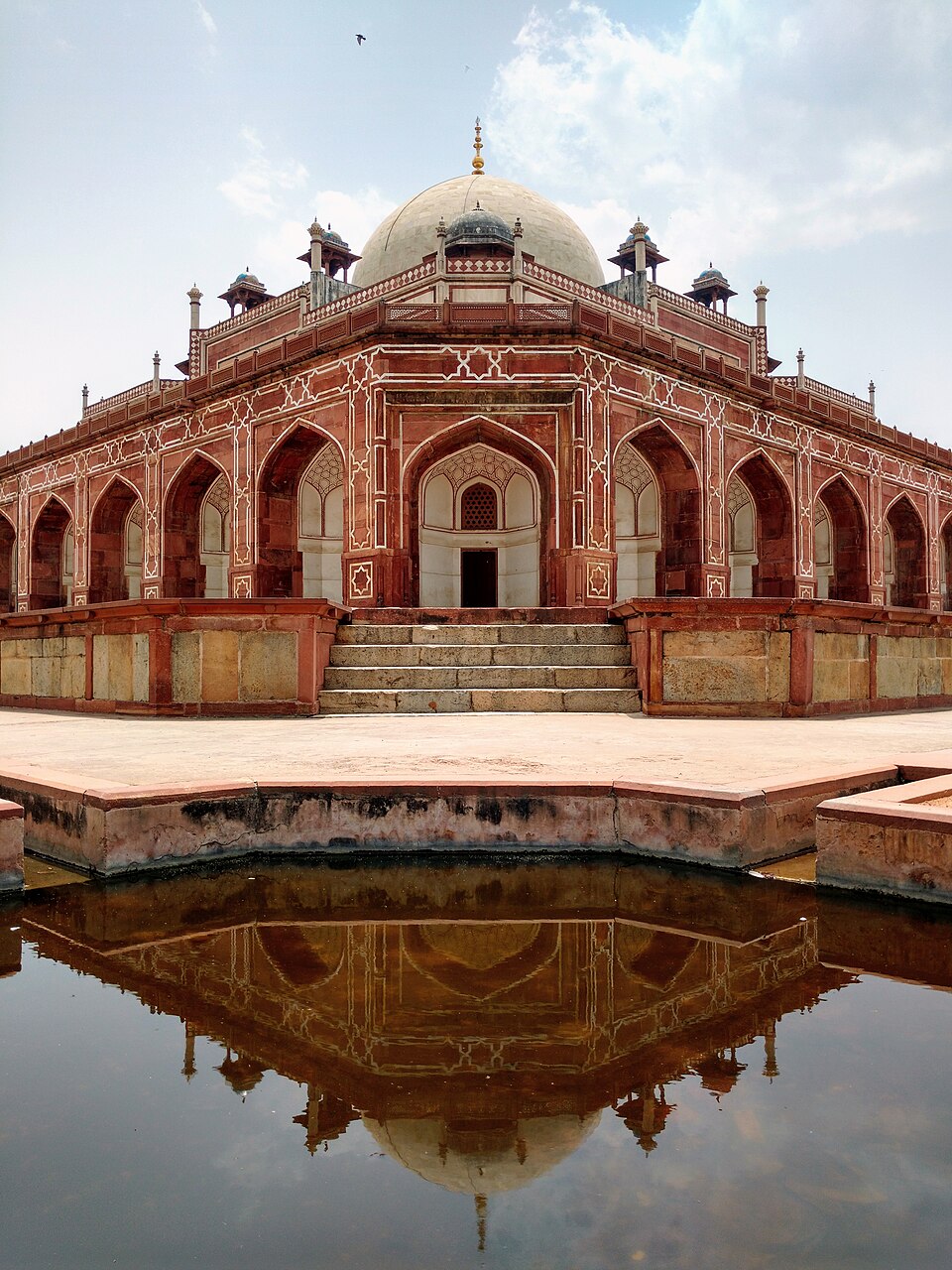
The approach to Humayun’s Tomb is part of its architecture. Paths, water channels and planted areas shape when the building appears and how its proportions are understood. Going directly to the closest photograph misses that gradual encounter. Try letting the garden introduce the tomb before studying its surfaces.
See the garden as an arrangement
Humayun’s Tomb is a major Mughal garden-tomb in Delhi. Its setting makes the connection between funerary architecture and an ordered landscape especially clear. The garden is not simply leftover space filled around a completed building.
Look for the relationship between the principal routes and the monument. A plan can help explain the division into quarters and smaller areas, but the lived experience depends on movement and viewpoint. Walk a permitted route slowly enough to notice how the building changes in relation to trees and gateways.
Compare distance with detail
From farther away, observe the dome, overall mass and raised platform. Closer to the building, attend to the contrast between materials and the framing of openings. Each distance offers different information; neither is the single correct way to see it.
Photograph a detail with enough surrounding wall to show its placement. An isolated patch of ornament may be attractive, but it is harder to connect with the overall design when you return to your pictures later.
Read restoration as part of the history
A conserved garden or repaired surface represents modern work as well as an inherited design. Look for interpretation explaining what was restored, what evidence informed the work and which organisations were involved. “Old” and “new” are not always visually obvious categories.
This is a chance to ask how historic landscapes are maintained. Planting, drainage and visitor routes need ongoing attention. The garden’s apparent calm should not make the labour behind its care disappear from the story.
Use the setting without losing its purpose
Visitors may value the site for photography, architecture or quiet time outdoors, but it remains a funerary monument. Keep behaviour appropriate to that setting, and respect restricted areas and instructions around the building.
A useful personal exercise is to describe the tomb from three positions along your approach. Which parts become visible first? When does its scale become clear? Those observations preserve something a single frontal photograph cannot: the way the design unfolds through space and the way a garden can prepare a visitor to encounter a monument.
Sources & further reading
UNESCO World Heritage Centre — site history and significance