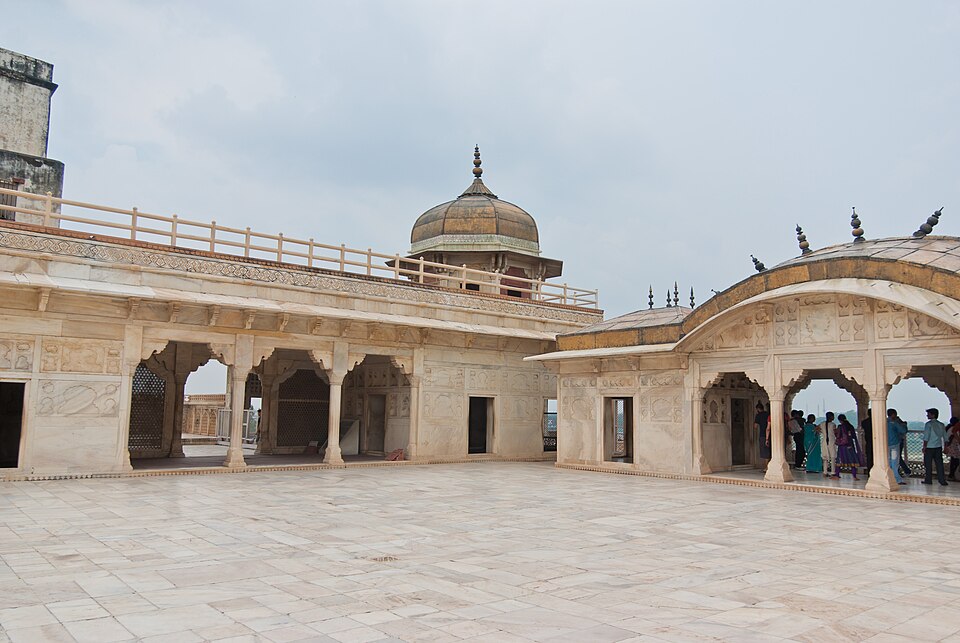
Agra Fort can surprise a visitor who expects only high walls and military space. Beyond the defensive appearance are courts, halls and more intimate architectural settings. The change in experience is worth following deliberately. A fort could protect a seat of power while also staging the public and private life of a court.
Keep the building phases visible
The fort’s Mughal history includes work by successive rulers. Differences in material and design should therefore prompt questions about phases rather than an assumption that everything was conceived at once. The UNESCO description provides a starting framework for studying the ensemble.
As you move through the accessible route, note where red sandstone and pale marble appear. Colour alone cannot date every surface, but a visible contrast can lead you towards the right historical question. Use the building’s own identification rather than the date of a nearby structure.
Look at the scale of an audience
An audience hall can be read through the relationship between a focal position and the space available to others. Where might attention have been directed? How would a visitor approach? Which parts of that approach were open, and which were controlled?
These questions help explain courtly architecture without requiring you to invent the exact position of every official. A room’s name is useful, but the spatial arrangement is what makes the name meaningful to a visitor standing inside it.
Treat views as evidence of setting
Views towards the river and the wider city remind us that the fort was not an isolated object. Water, approach routes and neighbouring places contributed to its position. A photograph taken through an opening should retain some of the frame if you want it to explain this relationship later.
Popular stories about particular occupants are memorable, but they need reliable historical support. Keep a dramatic anecdote separate from what the architecture itself shows. The two may enrich each other without becoming the same kind of evidence.
Choose a manageable comparison
Before leaving, compare one defensive feature with one courtly feature. Describe how each shapes movement and attention. This gives you a clear answer to the question of why the place is both a fort and a setting for elaborate architecture.
Follow the visitor route: parts of a large complex may not be accessible, and a closed area is not evidence that something mysterious is being concealed. A thoughtful visit works with what is responsibly open. Agra Fort becomes easier to remember when its spaces are connected by purpose, not just by the order in which your camera encountered them.
Sources & further reading
UNESCO World Heritage Centre — site history and significance