An elephant caught in water is a striking image because it reverses an expectation. An animal associated with power cannot free itself. In the story of Gajendra Moksha, that reversal becomes a way of speaking about devotion, dependence and help beyond one's own strength.
The familiar narrative
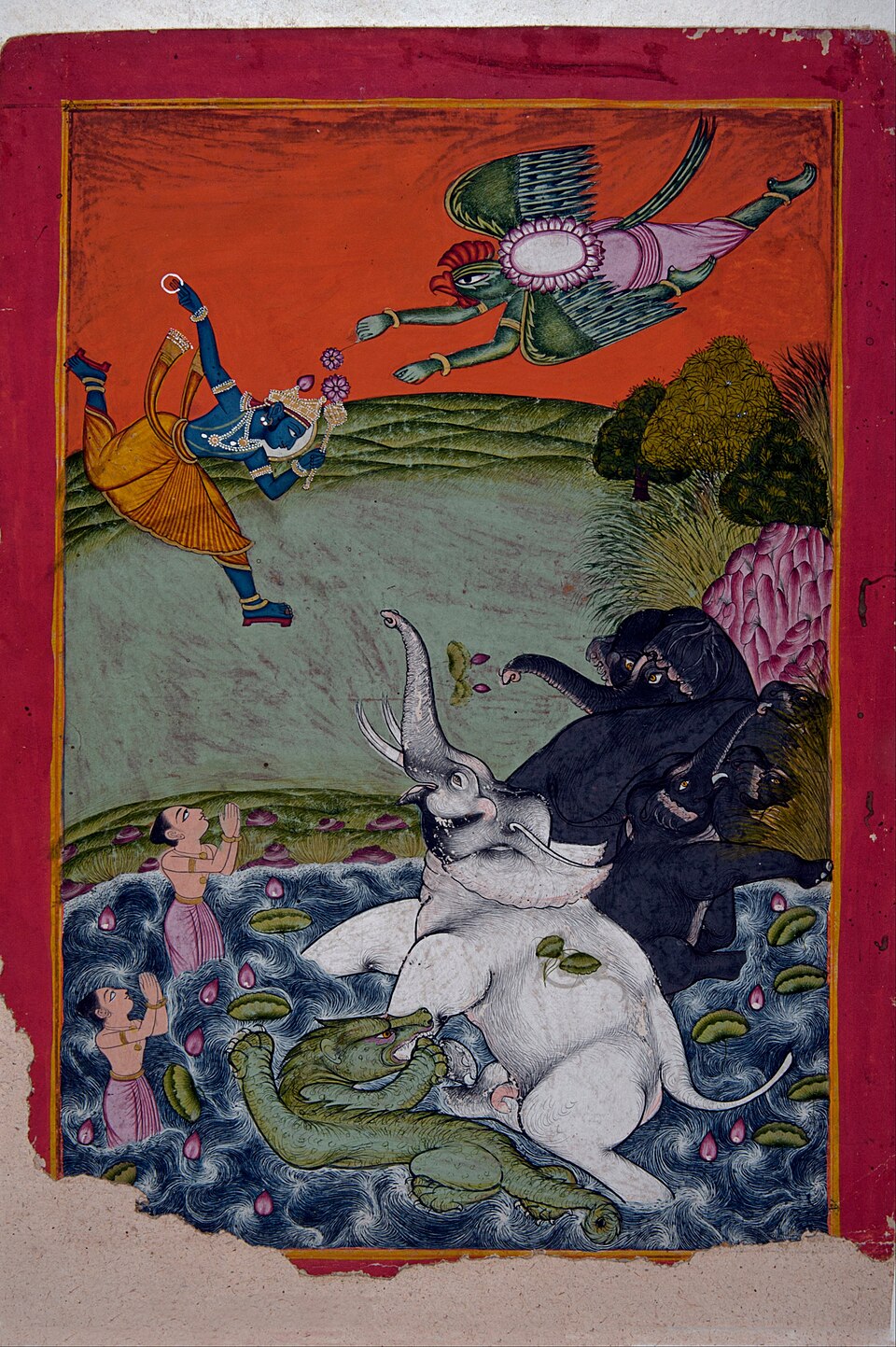
In a widely told account from the Bhagavata Purana, Gajendra is seized by a crocodile while in a lake. After a prolonged struggle, he appeals to Vishnu, who comes to his aid and grants liberation. The story is religious narrative; its significance does not depend on treating it as a report of an ordinary wildlife encounter.
The appeal matters as much as the rescue. Gajendra has reached the limit of what force can accomplish. Devotional readers see his turn toward Vishnu as an expression of surrender, while the title moksha points beyond simple escape from immediate danger.
Find the story in an image
Look for the elephant, the water and the arriving deity. Vishnu may be accompanied by Garuda. A lotus offered by the elephant can make devotion visible within the scene. Artists can change familiar details: a Kangra painting discussed by the Metropolitan Museum shows entangling vines instead of the usual crocodile.
That variation is a reminder to read the work you actually see. Do not add a crocodile to the caption of a painting where none appears. The artist's choices may emphasise a particular relationship or emotion rather than reproduce every element of the best-known retelling.
Strength does not remove vulnerability
One possible reflection is that capability and dependence are not opposites. A person may be experienced, respected or physically strong and still need help. This is an interpretation for discussion, not the only meaning of the story and not a promise that prayer removes every danger in ordinary life.
The story should not be used to blame someone whose difficulty continues. Suffering is not evidence that their devotion is inadequate. A compassionate reading can make asking for help less shameful rather than turning the rescue into a test that distressed people are expected to pass.
A question for a family reading
After telling the story, ask when Gajendra's situation changes and what the image makes visible about that moment. Younger readers may first notice the animal's size; older readers may notice the offered flower or the movement of Vishnu. These different observations can open a conversation without reducing the narrative to a single moral printed beneath a picture.