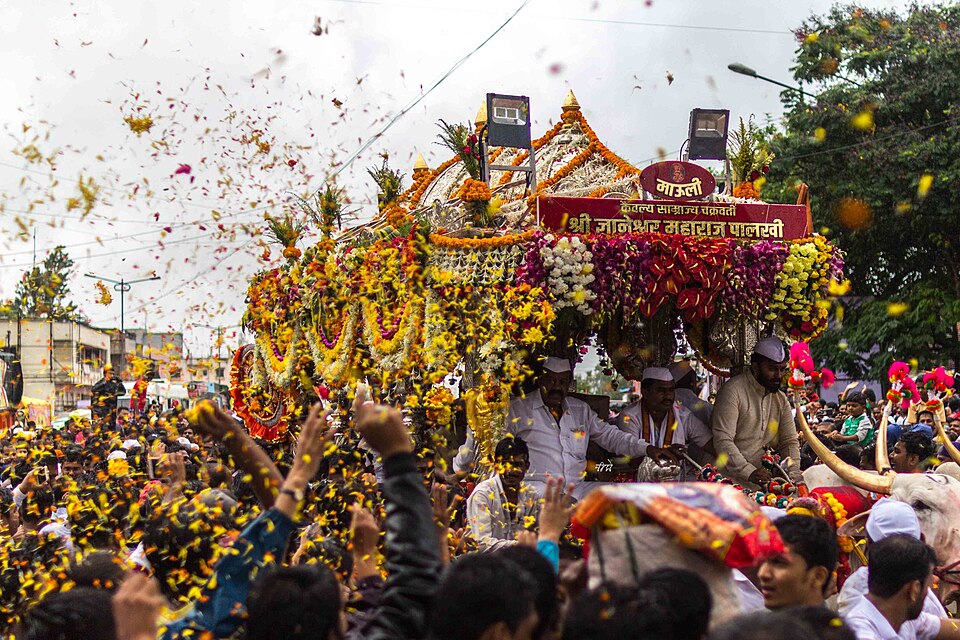
The memory of Sant Dnyaneshwar is carried not only in books and temple worship but also in the movement of the Wari. The palkhi associated with him travels from Alandi towards Pandharpur in the pilgrimage connected with Ashadhi Ekadashi. The journey brings a literary and devotional inheritance into shared public space.
What a palkhi represents
The palkhi honours the saint through a ceremonial presence carried in procession. It should not be confused with a claim that the saint's physical body is being transported. The practice allows remembrance to take a visible, collective form.
For an observer, it helps to ask which saint's palkhi is being followed. Dnyaneshwar's Alandi association and Tukaram's Dehu association belong to related traditions, but their names and places should not be swapped in captions or itineraries.
Walking as shared practice
The Wari involves more than movement between two points. Singing, coordination, rest and mutual assistance help make a group journey possible. A participant's experience may be shaped as much by these ordinary acts as by the most photographed moment.
Someone who offers water, helps with a meal or keeps the group together contributes to the pilgrimage's practical life. These tasks deserve attention when describing the event, rather than presenting the journey only as a mass of anonymous walkers.
Listen before explaining
A visitor unfamiliar with the tradition can begin by listening to the names, songs and forms of address used by participants. Ask respectfully about a term instead of assuming that a general description of pilgrimage explains every local practice.
If recording music or photographing people, seek permission where appropriate and avoid obstructing movement. A performance offered as devotion should not automatically be treated as free material for a personal channel.
Joining with a realistic plan
Check the current organiser's route and arrangements before deciding how much of the journey to join. Participation for a limited section is different from committing to the entire route. Choose an arrangement that suits the group and respects its organisation.
The connection with Dnyaneshwar can continue after returning home. Read a passage, learn the meaning of a song heard along the way or record a conversation with permission. In that way the journey becomes an opening into a tradition rather than only a collection of photographs.
.jpg)