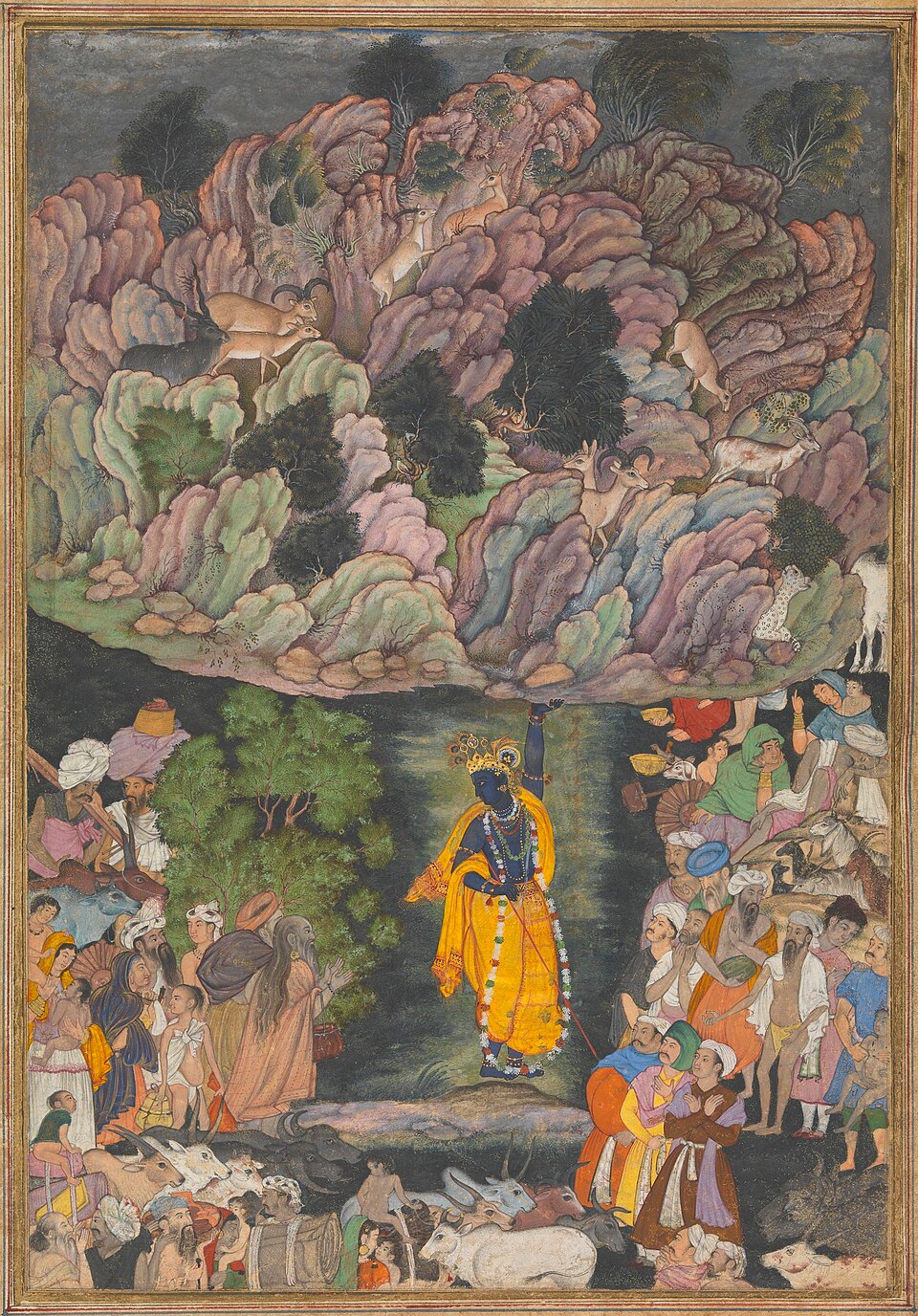
Krishna lifting Govardhan is both an extraordinary action and a scene of shared shelter. The mountain draws attention first, but the people and animals beneath it give the image much of its meaning. Looking at them changes the story from a display of individual power into a picture of a community facing danger together.
The familiar account
In Krishna traditions, a change in the community's offering provokes Indra's anger and destructive rain. Krishna raises Govardhan to shelter the inhabitants and their cattle. The story brings ritual, pride, protection and the life of a pastoral community into the same episode.
Different tellings develop the exchange with Indra in different ways. A short introduction should identify its broad narrative without pretending that every devotional explanation is identical. It is also useful to distinguish the story from the present customs associated with Govardhan Puja.
Look beneath the mountain
Count the kinds of activity in an image: people looking upward, animals gathered close, figures talking or waiting. Does the mountain resemble an umbrella, a rocky mass or a landscape filled with vegetation? The artist's choice affects whether the shelter feels intimate, crowded or immense.
A Harivamsa folio at the Metropolitan Museum, dated around 1590–95, belongs to the context of illustrated translations at Akbar's court. That history shows the narrative being interpreted within a particular artistic and literary project, rather than existing as one unchanging visual formula.
A question about protection
One possible reflection is that protection is meaningful because others can stand beneath it. The image invites attention to who is included in the shelter and how dependence is represented. This is more specific than reducing the story to a slogan that strength always wins.
The narrative can also prompt discussion about changing an inherited practice. What reasons are offered, who disagrees and what happens when authority is challenged? These questions belong to a careful reading; they need not be forced into one simple lesson about obedience or rebellion.
Connect a picture with a living observance
If visiting an Annakut or Govardhan celebration, ask hosts how they connect their offerings with the story. Record their own explanation rather than assuming every display follows the same arrangement. A photograph of a modern food offering and a painting of the mountain are related illustrations, but they show different things.
Keeping those distinctions in captions helps readers move between narrative, artwork and present practice. The story then becomes easier to explore in depth, without making every image stand for the whole tradition.