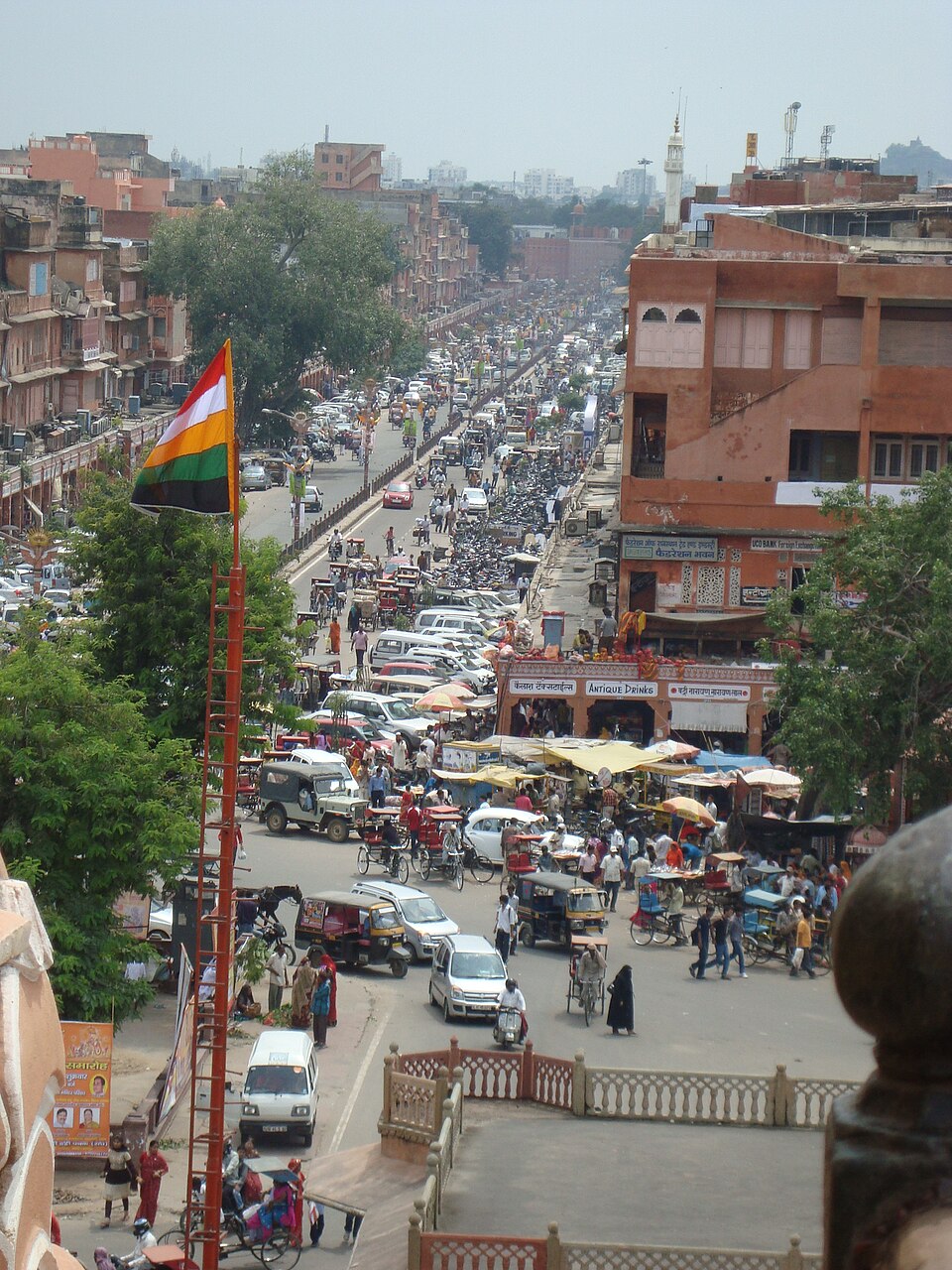
Jaipur’s familiar colour can make the city seem visually uniform from a distance. At street level, however, shopfronts, intersections, shaded edges and traffic reveal a much more varied experience. A useful heritage walk asks how the planned city is organised and how people continue to use it, rather than treating every pink facade as the same architectural object.
Start with a street, not a skyline
Jaipur’s historic urban form is associated with its eighteenth-century foundation under Sawai Jai Singh II. The UNESCO account discusses planning, commerce and craft traditions together. This makes a market street a legitimate place to begin understanding the heritage, not merely a route to the palace.
Choose a manageable stretch and observe its width, the rhythm of openings and the way smaller routes meet it. A city plan becomes more meaningful when you can connect a line on paper with a real crossing and a place to pause.
Compare a facade with its use
Look at what repeats across several buildings and what changes at ground level. A common frontage can contain very different businesses and daily activities. The relation between visual order and practical adaptation is part of the interest of an inhabited historic city.
Do not assume that matching colour proves matching age. Repairs, repainting and alterations affect the present appearance. If a specific building matters to your account, seek its own history rather than borrowing the foundation date of the entire city.
Let craft questions be specific
Instead of asking only where to buy a souvenir, ask how an object was made and who made it. A printing block, a setting tool or a sample showing stages of work can teach more than a general claim that everything in a shop is traditional.
Make room for a seller to be a retailer rather than pretending every purchase is directly from an artisan. Clear descriptions of origin and process are more helpful than a romantic story attached to an unidentified product.
Walk without becoming an obstruction
Pause away from doorways and crossings, especially when reading a map or photographing a long facade. Shopkeepers and residents need the street to function. The visitor’s enjoyment should not depend on temporarily stopping its ordinary life.
At the end of the walk, sketch one intersection and note two uses of the surrounding buildings. You will have a more concrete understanding of urban planning than a list of famous gates alone can provide. Jaipur’s design becomes especially interesting where the plan meets the changing demands of the people using it.
Sources & further reading
UNESCO World Heritage Centre — site history and significance