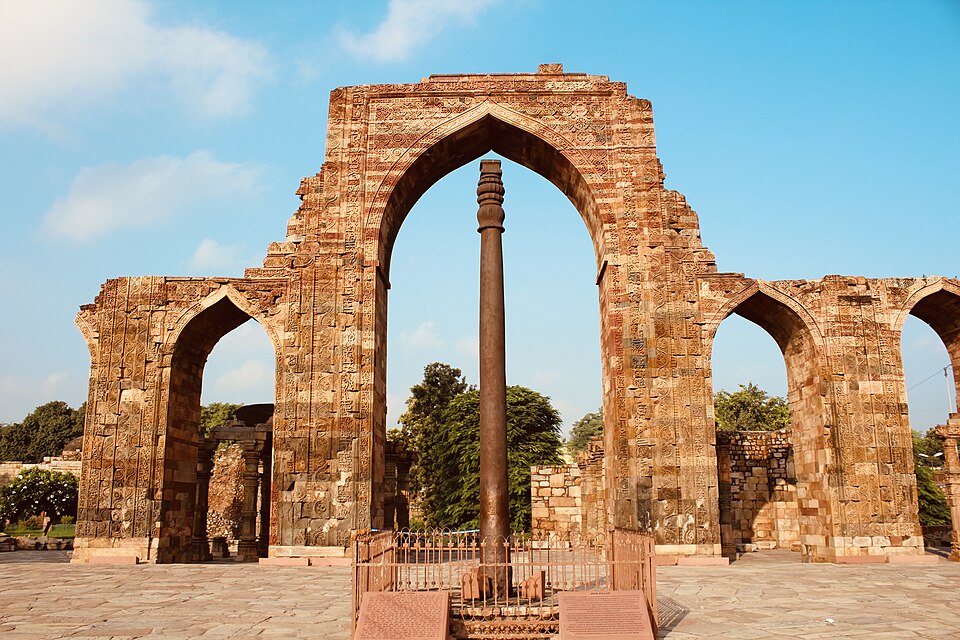
The iron pillar in Delhi’s Qutb complex often appears in articles with a claim that it has remained completely rust-free for sixteen centuries. A more careful question is why it has resisted corrosion so well. That question opens a discussion of materials, workmanship, environment and preservation without needing to call the object inexplicable.
Start with the object, not the slogan
The pillar is an iron monument with an inscription and a long history. Its current setting is part of the Qutb World Heritage complex. An account of the pillar should distinguish the object’s earlier history from the later monuments around it. Objects can move, and a shared location does not establish a shared date.
Read a reliable description of the inscription and its interpretation before repeating a precise attribution. Historical identification is based on evidence and argument, not simply on how confidently a guide names a ruler.
Corrosion resistance is not the absence of chemistry
The composition of the iron, the way it was produced and the surface layers formed over time are relevant to understanding its survival. Detailed explanations belong to materials research. A popular article should not replace that work with a claim that ancient metalworkers defeated the laws of nature.
It is also important to distinguish resistance from absolute immunity. “Never rusts” is a stronger statement than “has survived with remarkable resistance to corrosion.” Choosing the more accurate phrase does not reduce admiration for the workmanship.
Engineering has a human history
Producing a large iron object required knowledge, fuel, labour and organisation. Those practical requirements deserve attention alongside the familiar mystery narrative. Asking how people worked with available materials can reveal more than declaring that the achievement could not be reproduced.
If comparing the pillar with modern steel, specify which property is being compared. Strength, corrosion behaviour and manufacturing efficiency are different questions. One remarkable property does not automatically establish superiority in every respect.
Careful visiting
Follow barriers and do not touch or embrace the pillar for a photograph. Popular stories about physical contact should not override conservation rules. An object can be admired without adding wear to its surface.
Take a photograph that includes enough context to identify the setting, then a detail only where permitted. Afterwards, record which statements came from a heritage label and which came from a guide. The pillar becomes more interesting when questions are made precise and evidence is allowed to replace exaggeration.
Sources & further reading
whc.unesco.org — reference and further reading. Interpretive reflections and practical reading suggestions in this article are the website’s own explanatory material. Check current official arrangements before travelling.