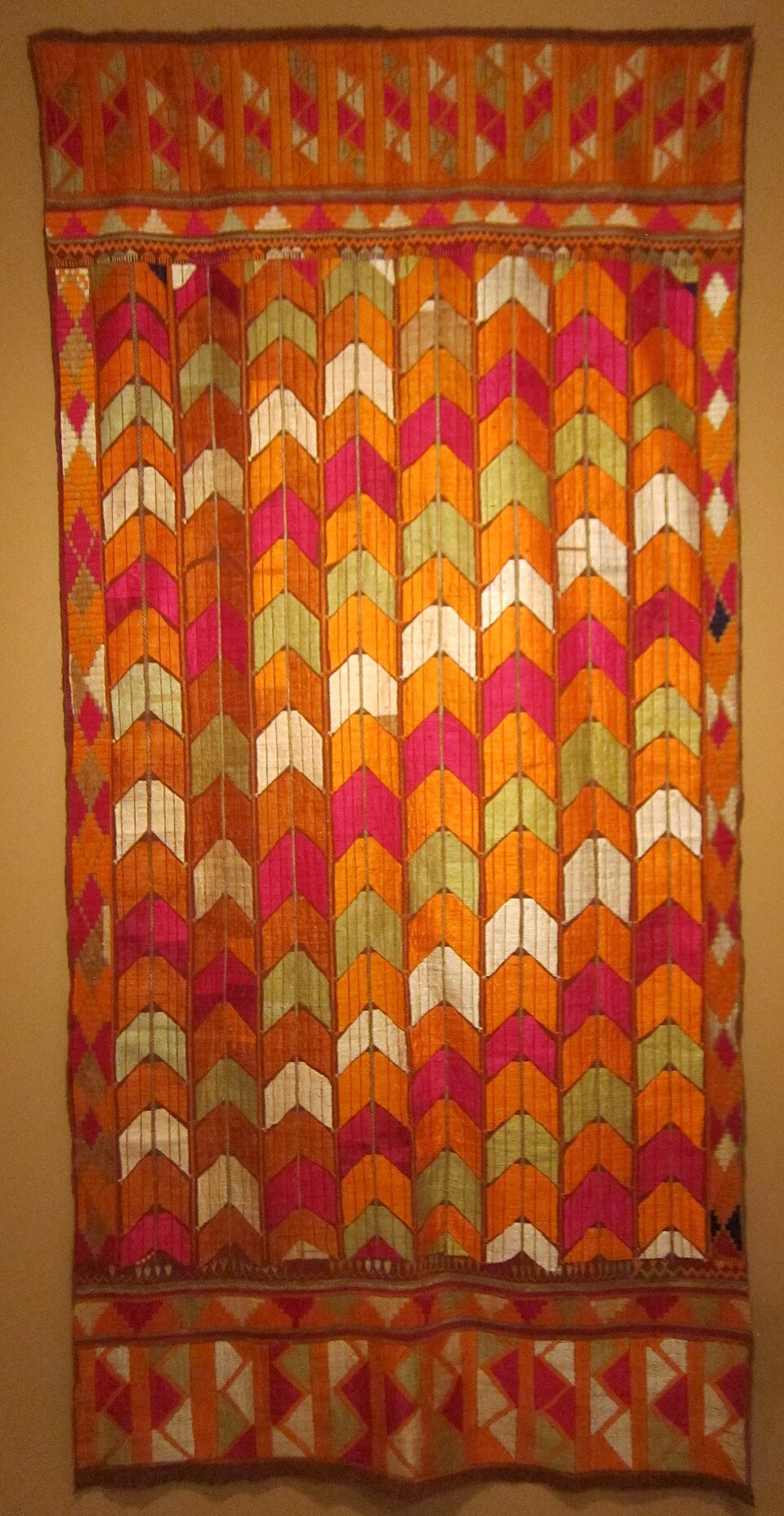
Phulkari can change as you move past it. Light meets the threads at different angles, making some areas appear brighter and others quieter. A photograph records one of those moments. Looking at the cloth itself, where possible, reveals how stitch direction contributes to an effect that colour alone cannot explain.
Keep the regional history broad enough
Phulkari is associated with the Punjab region and its histories across present-day borders. The name is often translated as flower work, but the designs are not limited to naturalistic flowers. Geometric organisation can be central to the visual effect.
Ask about the origin and type of the particular textile. A museum shawl, a recent hand-embroidered garment and a machine-made product inspired by Phulkari are different objects. An accurate description makes those differences understandable rather than hiding them beneath one label.
Look at thread against ground
Notice how much of the background cloth remains visible. Compare a densely worked area with a more open one. The balance between embroidery and ground affects the cloth’s rhythm and weight as a visual composition.
Then look at the direction of neighbouring stitches. Even threads of the same colour can catch light differently. This is a useful reason to view the cloth from more than one permitted angle rather than judging it only under a bright shop light.
Ask what is known about an older piece
Textiles are often accompanied by stories of weddings, inheritance and family use. Such histories can be valuable when they are traceable. Ask which details come from an owner’s record and which are general descriptions of the tradition.
A period estimate is not the same as a documented date. Keep uncertainty in the record instead of converting “probably early twentieth century” into a precise year. Good provenance can include honest gaps.
Choose a contemporary piece clearly
For a new purchase, ask about fibre, embroidery method and the people or workshop responsible. A machine-made design should not be sold through an unsupported claim of months of handwork. Equally, a modest handmade piece need not resemble a densely embroidered museum example to be worth appreciating.
Obtain care guidance and avoid harsh home cleaning experiments. When displaying a textile, consider the advice supplied for its material and condition. Phulkari becomes more rewarding when it is understood through the interaction of thread, light and ground, while the maker and history remain attached to the object rather than fading behind a generic festive label.
Sources & further reading
Official cultural reference — background and further reading