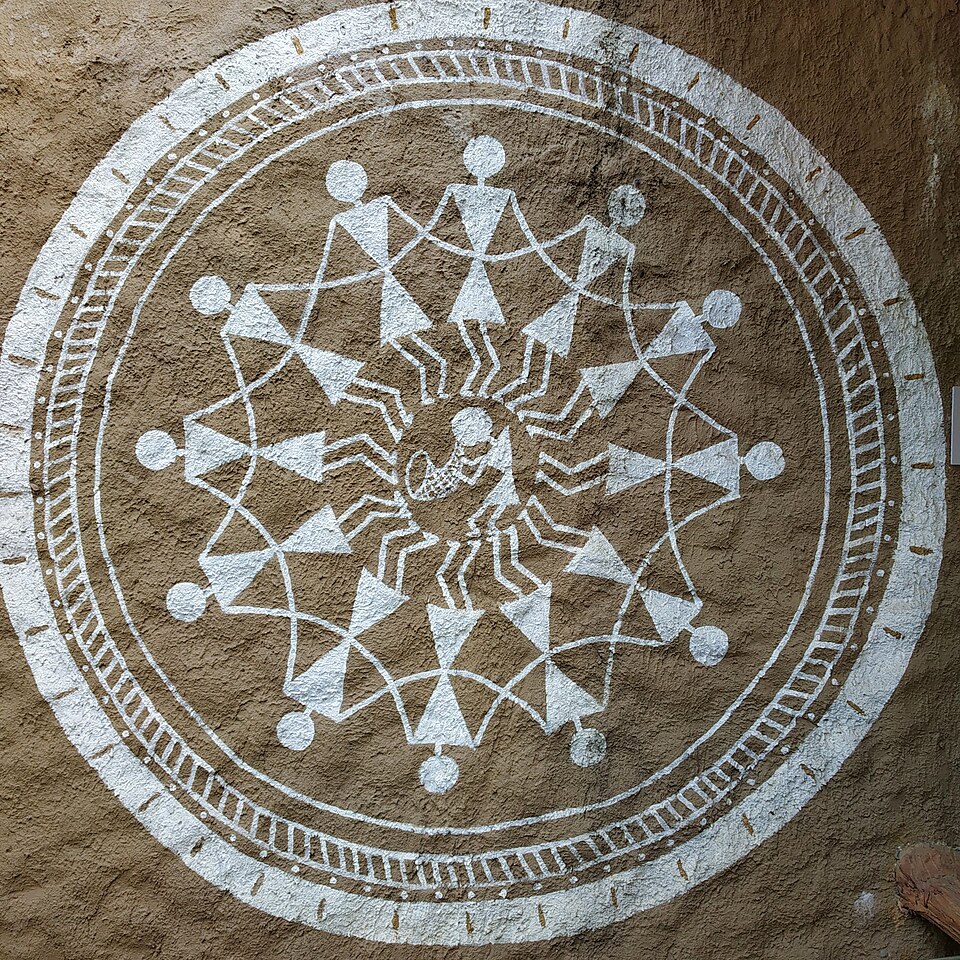
The apparent simplicity of a Warli figure can make it tempting to treat the form as an easy decorative pattern. Yet a painting is more than a collection of small geometric people. Their arrangement, the intervals between them and the activities they share can create a complex sense of movement and community.
Keep the people in the description
Warli painting is associated with Warli communities in western India, particularly the Maharashtra region and neighbouring areas. The name identifies a cultural tradition, not just any picture made from triangles and circles.
Contemporary artists work in different settings and on different supports. Ask the maker about the particular piece instead of assuming that a painting on paper has exactly the same purpose as a wall painting made for a specific occasion.
Watch the rhythm across the surface
Choose a line of figures and follow their spacing. Are they close together, widely separated or arranged around a centre? Notice how trees, animals or buildings interrupt or support the movement. The unpainted ground can be an active part of the composition.
An accessible exercise is to trace the route of your attention without touching the work. Where do you begin, and what leads you onward? This often reveals more than trying to assign a separate symbolic meaning to every small shape.
Avoid turning a tradition into a stencil
A classroom activity inspired by Warli art can introduce visual ideas, but it should be described as a learning exercise. It is not the same as becoming a practitioner or reproducing a community’s ritual work. Credit the tradition and introduce actual artists alongside the activity.
The same distinction matters in design. A commercial product using a familiar visual vocabulary does not automatically support the people associated with it. Ask who designed and made it, and whether the attribution is clear.
Listen to the individual artist
If a painting shows farming, gathering or celebration, ask the artist what the scene means in this work. Do not assume every picture describes an identical, timeless village life. Artists can choose what to remember, observe or imagine.
Keep a maker’s name, place and date with any purchase or permitted photograph. Those small details help prevent the work from becoming another anonymous “tribal design” online. A closer encounter with Warli painting can teach not only how a few forms make a lively composition, but also how attribution keeps cultural appreciation connected with living people.
Sources & further reading
Official cultural reference — background and further reading