A small fish that requires protection becomes a protector in turn. That reversal gives the Matsya narrative a memorable shape. Associated with Vishnu's fish incarnation, the story connects care, a threatened world and the preservation of what will be needed afterwards.
Several strands of a story
Flood accounts associated with a saving fish appear in Indian textual traditions, and later Vishnu narratives identify Matsya within the avatar sequence. Familiar versions include a warning, a vessel and the safeguarding of life or knowledge. Accounts involving the recovery of the Vedas are also important in Matsya imagery.
These strands should not be merged carelessly. If a work shows the rescue of sacred texts, a caption should not insist it depicts a boat merely because that is the viewer's best-known version. Identify the source account where possible.
Recognise the form
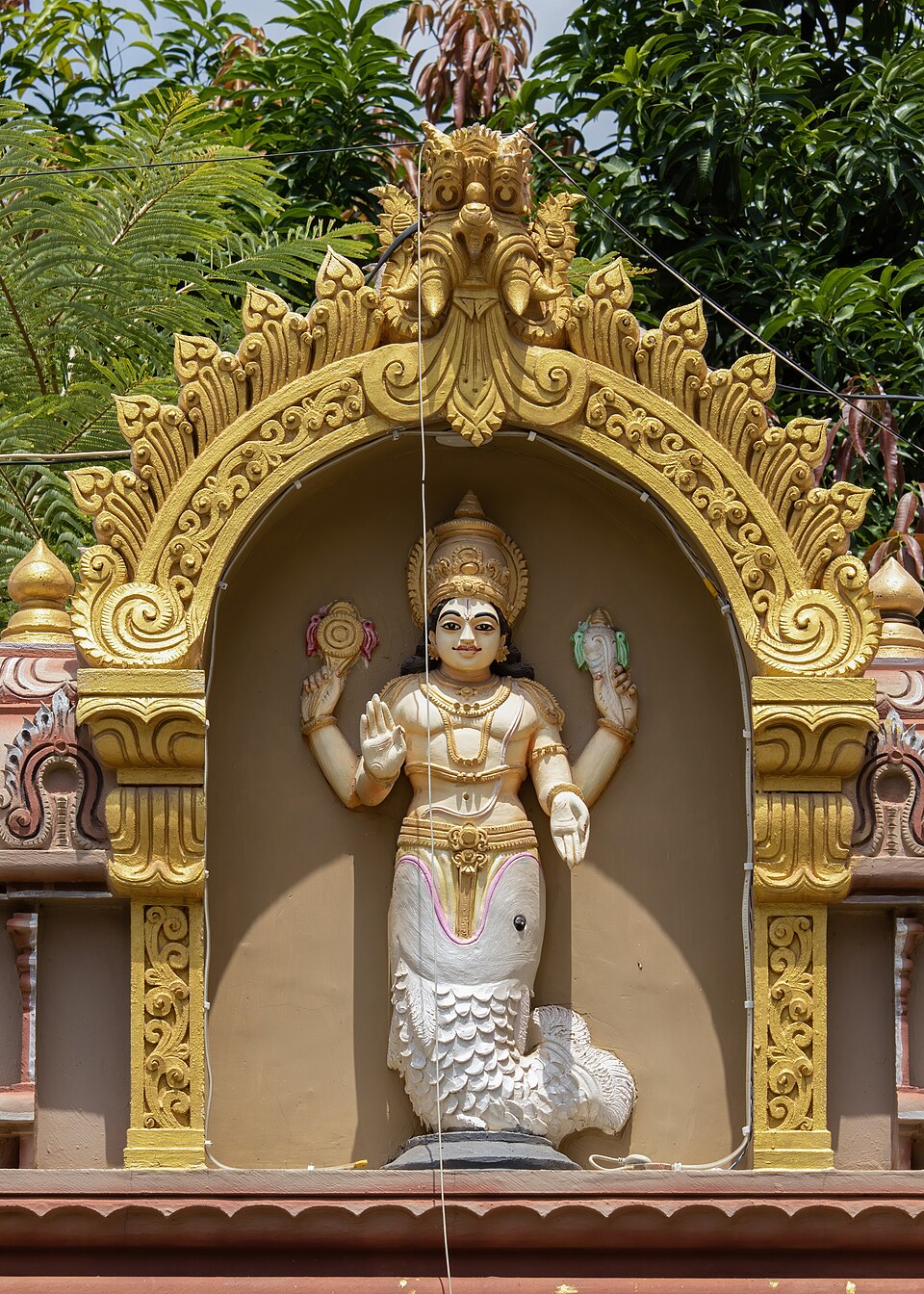
Some representations show a fish; others combine a fish body with Vishnu's human upper body. Attributes such as the conch and discus can make the identity clearer. The British Museum's description of a Thanjavur painting, for example, draws attention to those attributes and to the carefully painted fish.
Look at how the artist connects the two forms. Does the tail balance the arms or ornaments? Is the surrounding water shown? These visual decisions make the image more than a diagram illustrating a name in a list of ten avatars.
What is worth preserving?
One possible reading asks what a community carries through disruption. Seeds, living beings, knowledge and responsibilities all offer points for discussion within the broad narrative of preservation. The question becomes especially interesting when the smallest creature first requires someone's care.
This does not mean the story supplies a scientific account of a global flood or a substitute for actual emergency planning. Its religious and imaginative value can be explored without claiming that every geological observation confirms the narrative.
Try a focused comparison
Compare a fish-only representation with one that has Vishnu's upper body. Note what each makes easier to recognise and what it leaves unexplained. Then read their captions for place, date and source tradition.
The exercise encourages a useful habit: begin with the evidence of the object before filling in the entire story from memory. Matsya is a subject in which the relationship between image and narrative is especially visible, because artists have several distinct ways to show a protector who takes a fish's form.