The Confluence of Vaishnavism and Shaivism
At the southernmost tip of the Indian peninsula, where the tranquil waters of the Gulf of Mannar meet the rolling waves of the Palk Strait, stands the grand Ramanathaswamy Temple at Rameshwaram. It is one of the four cardinal Maha Dhams of India and the southernmost of the twelve Jyotirlingas. But its supreme philosophical beauty lies in its demonstration of the indivisible harmony between Bhagwan Vishnu and Bhagwan Shiva.
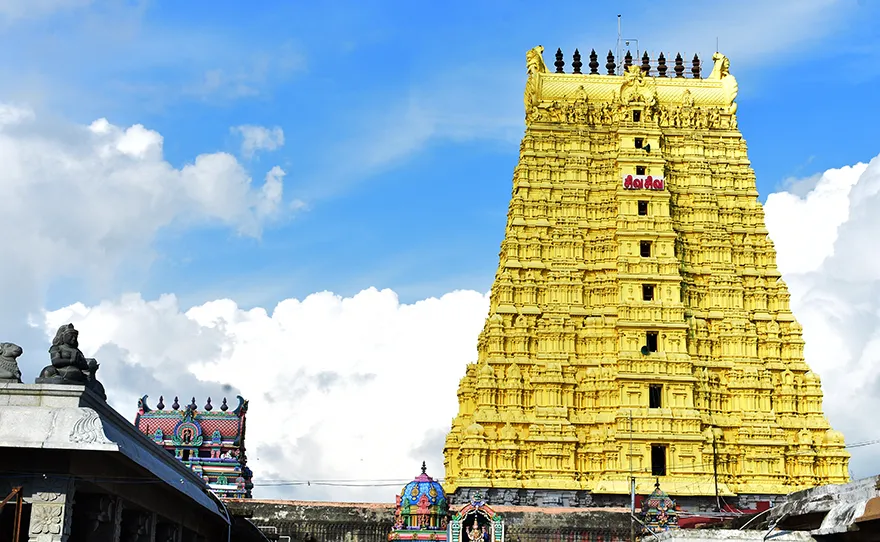
The sacred corridors of Rameshwaram on Pamban Island, Tamil Nadu.
The Burden of Brahmahatya: Ravana’s Pedigree
Although Ravana was a tyrannical demon king who abducted Devi Sita, he was also the great-grandson of Lord Brahma and a deeply learned Vedic scholar. Slaying him, even in a righteous war of liberation, incurred the karmic residue of Brahmahatya Dosha. Before launching his expedition across the newly built Ram Setu bridge, Sri Rama sought to atone for this impending sin by performing a grand worship of Lord Shiva.
The Two Lingams: Ramalingam and Vishwalingam
Rama dispatched Hanuman to Mount Kailash to bring an auspicious Lingam directly from Shiva. However, as the designated planetary muhurta for the consecration approached, Hanuman had not yet returned. To ensure the ritual was completed on time, Devi Sita lovingly crafted a Shiva Lingam out of ocean sand with her own hands—the Ramalingam.
When Hanuman finally arrived carrying the Kailash Lingam, he was crestfallen to find the ritual already completed. Noticing his sorrow, Sri Rama compassionately decreed that Hanuman’s Lingam (the Vishwalingam) would be installed alongside Sita’s sand Lingam, and that for all future generations, devotees must worship Hanuman’s Vishwalingam first before offering prayers to the Ramalingam—a tradition faithfully observed to this day.