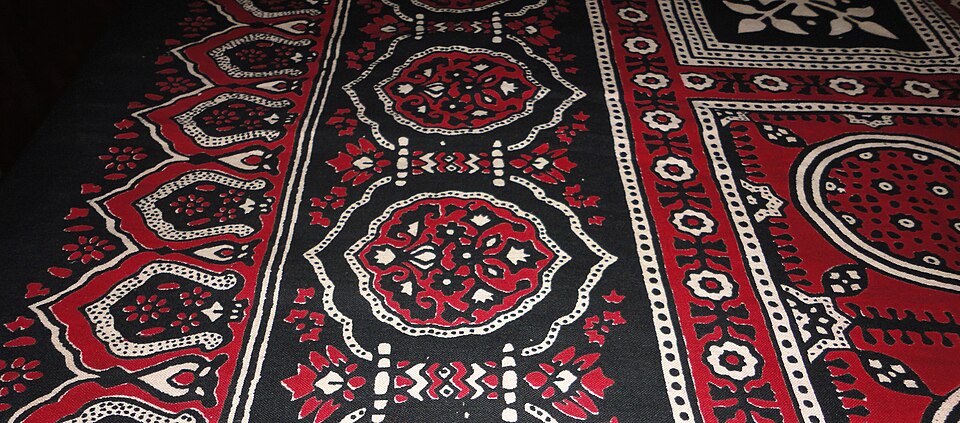
An Ajrakh cloth rewards looking for what repeats and what changes. A small geometric unit may join its neighbours so smoothly that the separate impressions disappear into a larger field. Behind that visual continuity are choices about blocks, colour and alignment. Understanding the sequence makes the textile more interesting than describing it only by its familiar red and blue tones.
Place the craft in a wider region
Ajrakh or Ajrak belongs to a textile tradition associated with Sindh and with communities in Kutch and other parts of western India. Ajrakhpur in Kutch is one place where block printing continues. The regional connections should remain visible rather than being reduced to a claim that every example comes from one village.
Ask where the particular cloth was made. A photograph of an Ajrak textile from Sindh can illustrate the broader tradition, but it should not be labelled as evidence of production in a Kutch workshop.
Follow the layers of a pattern
Look for the outline, the coloured areas and the spaces between them. In a workshop demonstration, ask which block or stage produces each part. Seeing a sample at an intermediate stage helps explain a finished design that otherwise looks as though it appeared all at once.
Registration is the alignment between impressions. Small variations can reveal manual work, but they are not a complete authenticity test. A convincing description should include the process and maker rather than depend solely on visible imperfection.
Ask about materials without assuming
Ajrakh is often discussed in connection with natural dyes and multiple stages of treatment. For a contemporary purchase, ask which process was used on that specific piece. The craft name alone does not guarantee identical ingredients, fibre or finishing across every product.
Care instructions should come with the cloth. A seller’s explanation of washing and drying is more useful than an unverified claim that a traditional dye can never change. Avoid trying chemical tests at home to authenticate a fabric.
See a working workshop respectfully
Printing tables, wet cloth and drying areas are part of production, not merely scenery for visitors. Ask where you may stand and photograph. Do not handle a block or touch a printed surface without invitation.
Keep the printer or workshop’s name with a purchase. When sharing a permitted image, explain the stage of work shown if you know it. That creates a more useful record than a close-up called simply “Indian textile,” and it connects the ordered beauty of the pattern with the practical knowledge that produces it.
Sources & further reading
Official cultural reference — background and further reading