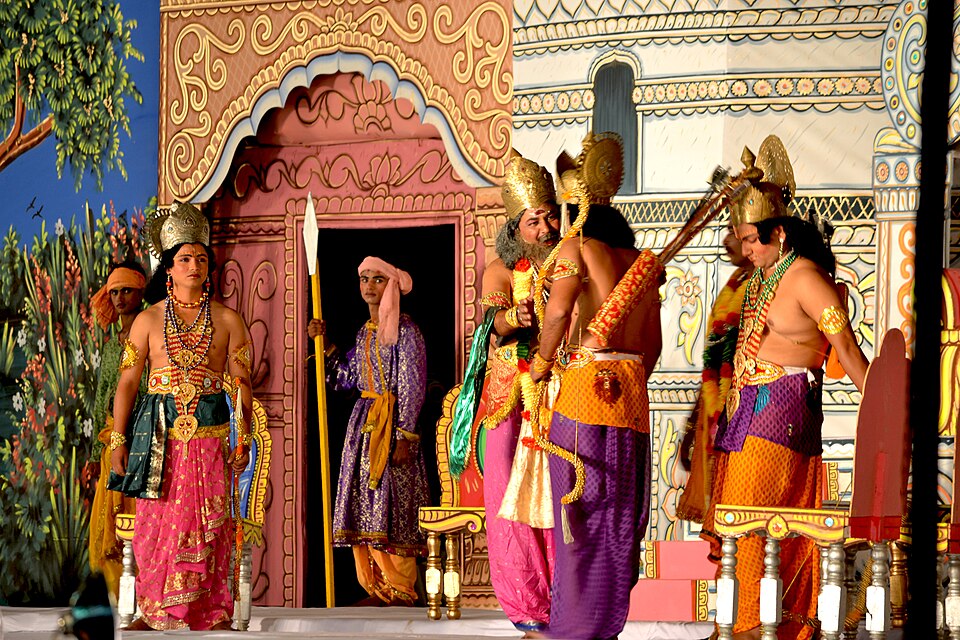
The audience at a Ramlila may know the broad story before the first scene begins. Familiarity does not remove the interest. It changes it: attention can move towards delivery, music, characterisation and the way a local community brings a well-known episode into shared space.
Learn which version is being performed
Ramlila stages stories associated with Rama, drawing on a range of local performance practices. Many traditions are closely connected with the Ramcharitmanas, but no short description should imply that every production uses exactly the same text, language or sequence.
Ask which episode is scheduled and whether the performance belongs to a longer cycle. An evening may make more sense when you know what the audience watched previously and what will follow. A synopsis is helpful; it need not become a substitute for listening.
Watch how a place becomes a stage
Some presentations use a fixed stage, while others make important use of movement and a wider setting. Notice where the audience directs attention and how performers enter or travel. The arrangement can shape the story as strongly as a painted backdrop.
Do not cross a performance route because it looks like an ordinary public path. Follow the organisers’ instructions and leave space for people whose work involves moving props, instruments or performers between scenes.
Include the work outside the spotlight
Costumes, rehearsal, sound, lighting and the coordination of volunteers all contribute to an event. If an organiser explains how preparations happen, ask about a concrete task rather than assuming the performance appears spontaneously each year.
Children or young performers may be involved in some productions. Ask before taking close photographs, and follow the event’s policy on recording and publication. Being on a public stage should not be treated as blanket permission for every use of an image.
Listen without demanding novelty
An audience’s pleasure in a familiar line or entrance can be part of the performance’s life. A first-time visitor does not need to share every reference to recognise that relationship. Observe when people respond and ask afterwards what made the moment significant.
When discussing the event, identify the troupe, place and episode rather than claiming to have seen the definitive Ramlila. Local differences are part of the subject. A precise account of one evening can illuminate how an epic is performed, remembered and renewed without flattening many traditions into a single standard show.
Sources & further reading
UNESCO Intangible Cultural Heritage — tradition and community context