Listening to Buddhist chanting in Ladakh can be moving even when the words are unfamiliar. The experience becomes more meaningful when unfamiliarity leads to respectful questions rather than invented explanations. Sound, text and religious purpose belong together; a recording of an atmospheric voice captures only one part of that relationship.
Learn the occasion
The heritage practice described by UNESCO concerns recitation of sacred Buddhist texts in Ladakh. Chanting occurs in religious and community contexts, with practices that should not be assumed identical across every monastery or occasion.
Before attending, ask whether visitors are welcome and what is taking place. A public event, a daily observance and a private ceremony may have different expectations. An open doorway is not a substitute for that information.
Listen without assigning a meaning too quickly
Notice the phrasing, the alternation of voices and the use of pauses. If instruments accompany the recitation, listen to how they relate to the voices. You can describe these audible features without claiming to know the meaning of the text.
For meaning, seek an explanation of the specific text and the tradition in which it is being used. A generic online translation labelled “Buddhist chant” may have little connection with what you heard. The name of the text is a useful starting point for later learning.
Treat books and ritual objects appropriately
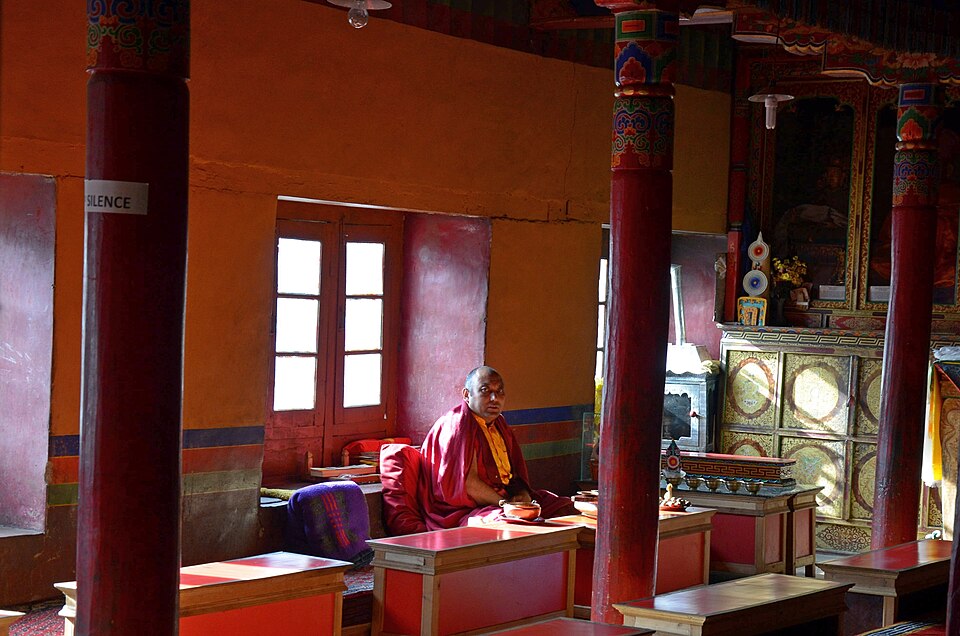
Sacred texts and objects may have handling rules unfamiliar to a visitor. Do not touch, reposition or use them as photographic props. If someone offers to show an item, follow their instructions and ask before taking a close image.
The same consideration applies to people reading or reciting. A person’s concentration should not be interrupted for a portrait. Photographing from a respectful distance is still subject to the setting’s rules, particularly when recording sound or video.
Let the visit remain a visit
It is not necessary to imitate gestures or join recitation you do not understand. Quiet attention and appropriate behaviour can be sufficient. If a guide explains an action, follow it only within the invitation and your own comfort.
Keep the location, occasion and any public attribution with your notes. Avoid describing all of Ladakh through one short encounter. A careful account can say what you heard, what was explained and what you still want to learn. That honesty preserves the religious context while allowing a newcomer to appreciate the discipline and continuity carried through the voice.
Sources & further reading
UNESCO Intangible Cultural Heritage — tradition and community context