The Qutb complex is often photographed as one tall tower with a few surrounding ruins. A slower visit reveals something more complicated: inscriptions, reused material, additions and unfinished ambitions. Treating the ensemble as a sequence of building activities makes it more understandable than assuming every element belongs to one unified moment.
Let inscriptions raise questions
The minaret’s carved bands are part of its visual character, but their texts should be approached through reliable readings. A visitor who cannot read the script can still observe placement, scale and the relationship between lettering and ornament.
Avoid attaching a translation found on an unrelated image. Record the particular band or panel you are studying, then look for an identification that matches it. The distinction is small but important when photographs circulate without precise captions.
Notice different kinds of stonework
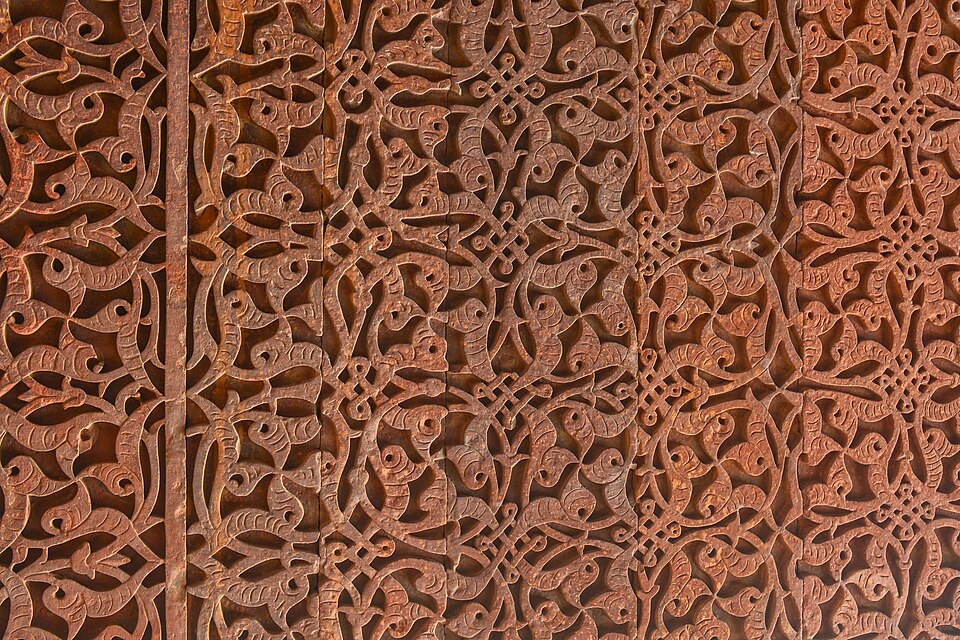
In the wider complex, changes in carving and construction invite questions about how material was used and reused. Those questions belong to a documented, sometimes contested history. They deserve specific explanation rather than a broad modern slogan about an entire community.
Compare forms carefully and consult interpretation about the relevant structure. A carved element can preserve evidence of an earlier context, but identifying that context requires more than resemblance. Keep what you observe separate from what a source establishes.
Understand incomplete work
An unfinished or fragmentary structure can show intention without showing a completed design. Ask which parts survive, what is known about the proposed project and what remains uncertain. An incomplete monument is not simply a failed version of the tower beside it; it has its own historical circumstances.
The iron pillar is another distinct object with a different history. Its presence should not lead you to assume that its making and the minaret’s construction were contemporary. Reading the ensemble means learning to hold different dates together.
Make an evidence notebook
Choose one inscription, one change in material and one unfinished feature. For each, write an observation and then the explanation supplied by a named source or site panel. You will be able to see where your knowledge came from and where it is still incomplete.
Stay within the public route and follow restrictions around fragile surfaces. The purpose of a visit is not to resolve every historical debate in an afternoon. It is to gain a clearer sense of how historians and architectural researchers build explanations from surviving material rather than from a striking silhouette alone.
Sources & further reading
UNESCO World Heritage Centre — site history and significance