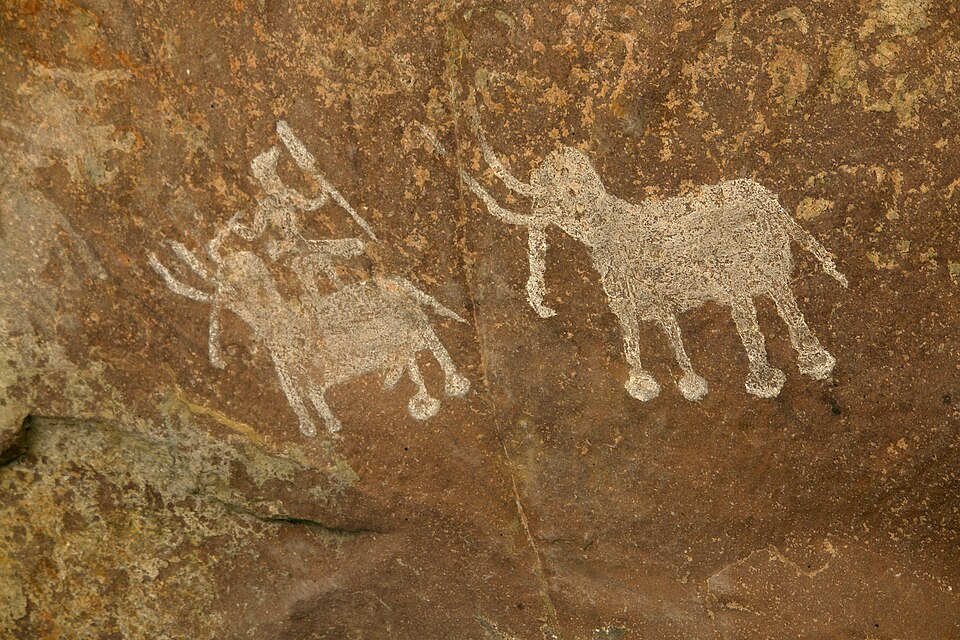
Rock paintings at Bhimbetka can feel immediately approachable: an animal, a moving figure or a group may seem familiar. That familiarity is also a trap. Recognising a shape does not mean we know the artist’s exact intention. The most useful first response is a careful description, followed by questions that respect what remains uncertain.
See the shelter as well as the image
Bhimbetka’s rock shelters in Madhya Pradesh preserve evidence of human activity over a long span. The painted surfaces belong to a landscape of natural formations, not to a modern gallery where each work was designed for a separate frame.
Notice the shape of the shelter, the height of the painted area and the available viewpoint. Do not assume every image was made at the same time. Published archaeological interpretation is needed to discuss phases and dates responsibly.
Describe before interpreting
Start with visible features: colour, outline, number of figures and their relation to one another. If an animal is uncertain, write “four-legged animal” before adopting a more specific identification from the site’s interpretation.
Likewise, a group of moving figures may invite a suggestion of hunting, dancing or gathering, but the suggestion should be identified as such. A scene does not become proof of a detailed ceremony because a modern viewer finds that explanation appealing.
Pay attention to overlapping marks
Where paintings overlap, the surface can preserve a sequence rather than one unified composition. This is a reason to look carefully, not to trace the marks with a finger. Touching, wetting or applying anything to rock art can damage the material being studied.
Phone editing can also create false confidence. Increasing contrast may make a faint image easier to see on a screen, but it can distort the relationship between colours and marks. Retain an unaltered reference image where photography is permitted.
Make children part of the observation
A family visit can begin with simple prompts: find a repeated shape, compare the size of two figures, or describe where a scene sits on the rock. These questions do not require children to memorise a speculative explanation.
Keep to permitted paths and follow the site’s instructions around shelters. The value of the visit lies partly in learning restraint: we can be curious without touching, and impressed without claiming to know everything. Bhimbetka offers a rare chance to practise that balance in front of marks left by people whose individual voices are no longer directly available to us.
Sources & further reading
UNESCO World Heritage Centre — site history and significance