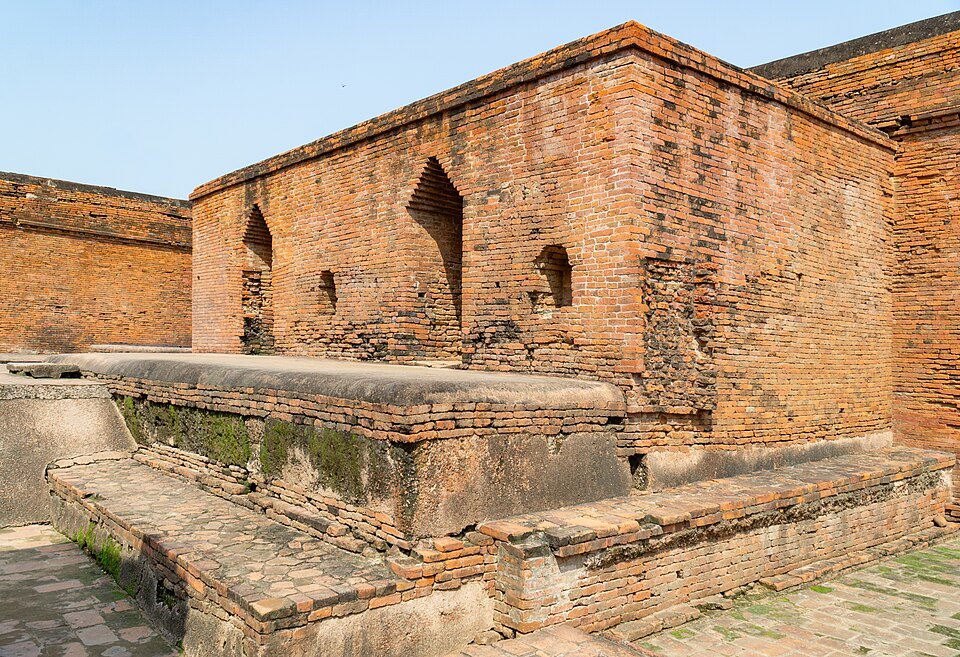
At Nalanda, rows of brick walls can initially look difficult to interpret. The answer is not to invent a busy classroom in every enclosure. Begin with a plan and a modest question: how were living, learning and religious spaces arranged in relation to one another? The ruins become more legible when the visitor learns to read their surviving organisation.
Start with the monastic setting
Nalanda Mahavihara was a major Buddhist monastic and educational centre in Bihar. The archaeological site preserves remains from a long institutional history. Calling it a learning centre is useful, but equating every aspect of it with a present-day university can conceal differences in religious life, patronage and organisation.
Use the site’s numbered areas to orient yourself. Match the plan with what is visible on the ground before accepting a detailed explanation of how a particular room was used. Not every identification can be made from shape alone.
Read one monastery slowly
Look at the relationship between a courtyard and the rooms around it. Where are the approaches? Which walls survive high enough to suggest enclosure, and which features require interpretation from excavation records? Distinguishing visible evidence from reconstruction is a basic archaeological skill.
Try a simple drawing with the courtyard at its centre. Add only the openings and spaces you can confidently locate. This exercise encourages attention to arrangement rather than the temptation to repeat dramatic numbers about students or libraries without a source.
Connect objects with buildings
A museum visit, where available and open, can complement the ruins. A sculpture or seal has a material, a find history and a catalogue description. Those details can bring institutional life into focus in ways a distant view of brickwork cannot.
Keep an object’s identification with its photograph. Do not assume every image from the region was found in the exact monastery you walked through. Provenance is the link between an attractive object and the history it can responsibly help explain.
Leave room for historical complexity
Nalanda’s history is often compressed into a single story of greatness followed by destruction. Such a summary misses centuries of change. Ask about phases of building, networks of travel and the sources historians use to reconstruct intellectual life.
The ruins cannot answer every question by themselves, but they can sharpen the questions. A visit that teaches you to distinguish an excavated wall, a proposed room function and a documented institutional relationship has already achieved something substantial. It turns admiration into a beginning for further study.
Sources & further reading
UNESCO World Heritage Centre — site history and significance