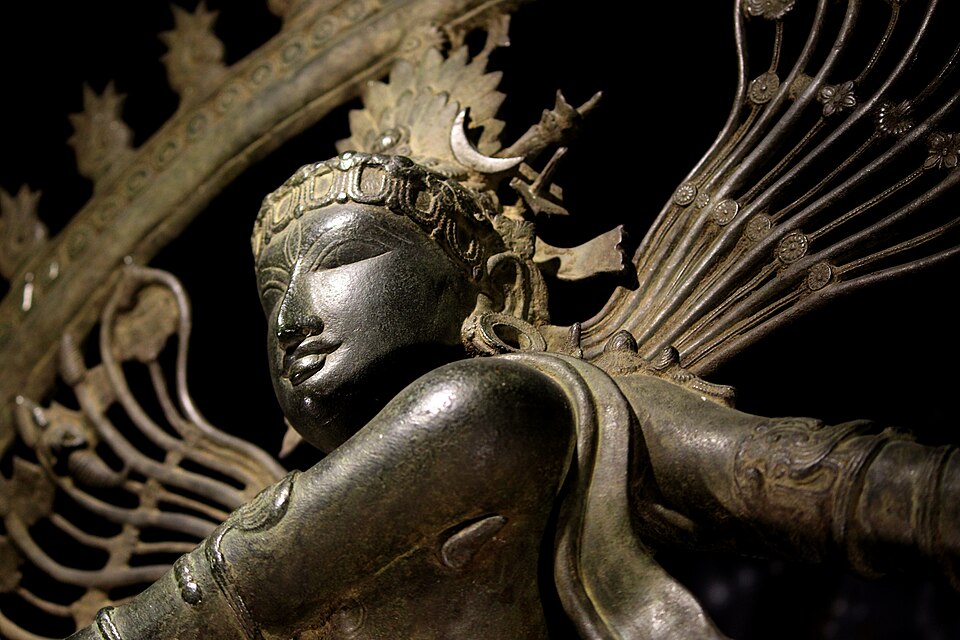
The first thing to notice in a Nataraja image is the contrast. Shiva moves inside a circle of flame, yet his face is composed. The sculpture holds movement and stillness together. That contrast makes it a useful introduction to Hindu religious art: meaning often comes from the relationship between details, rather than from one object considered alone.
Begin with the hands and feet
In a familiar form of the image, one upper hand holds a small drum and another holds fire. Devotional explanations connect these with creation and dissolution. A lower hand offers reassurance, while the other directs attention towards the raised foot. The figure beneath the standing foot is commonly understood as a personification of ignorance. These are elements of a religious visual language, not a diagram of machinery.
The raised foot matters because the composition does not end with destruction. It also offers refuge and release. Seen this way, the dance is not simply a frightening picture of a world being destroyed. It places change, protection and liberation within a single image. Different teachers may develop these ideas differently, so it helps to ask which tradition or commentary an explanation follows.
Why the bronze medium matters
Metal allows the surrounding ring, extended limbs and flowing hair to form a connected but open structure. Walk around a museum display, when permitted, and notice the spaces between the limbs. Those openings contribute to the impression of movement. A photograph taken straight on can make the sculpture seem flatter and more symmetrical than it feels in person.
Chola bronzes are especially associated with this subject. Their appreciation should include the skill of metalworkers and the role of images in worship, rather than treating them only as beautiful objects. A museum label can help establish the date, material and provenance of a particular example. Not every Nataraja image is a Chola original, even when it uses a familiar design.
Is the dance a statement about physics?
Modern writers have compared the image with a dynamic universe. That can be an evocative analogy, but it is not evidence that the sculpture encodes quantum field theory. Religious symbolism and scientific explanation answer different kinds of questions. We can appreciate the image fully without claiming that ancient artists anticipated a particular modern equation.
A useful exercise is to separate observation from interpretation. “The hand holds fire” describes what is visible. “Fire represents dissolution” offers a traditional interpretation. “The fire proves a theory of particles” makes a scientific claim that would require independent evidence. Keeping these levels separate makes the article more respectful of both art and science.
Looking slowly
Choose one image and spend a minute on the face, another on the hands, and another on the feet. Read its museum description after looking, then return to the sculpture. This small change of pace often reveals more than collecting a long list of supposed secrets. The dance invites attention; it does not need exaggerated claims to remain compelling.
Sources & further reading
www.metmuseum.org — reference and further reading. Interpretive reflections and practical reading suggestions in this article are the website’s own explanatory material. Check current official arrangements before travelling.