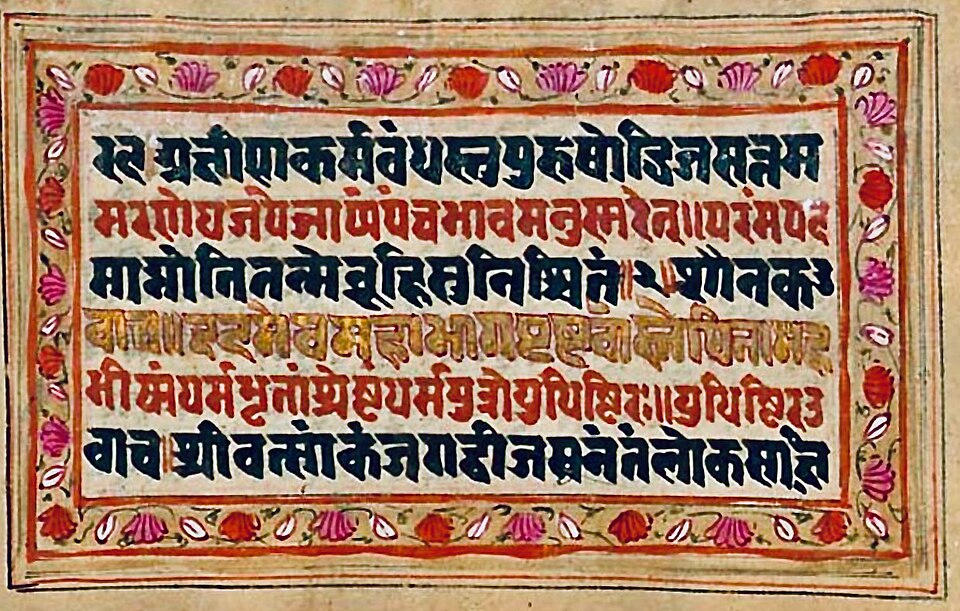
The three gunas are qualities used in Indian philosophical traditions to describe the workings of prakriti, or nature. Sattva, rajas and tamas also appear in the Bhagavad Gita’s discussion of conduct and experience. They are useful to study as a conceptual framework, but not as three permanent labels for sorting people.
A vocabulary of tendencies
Sattva is commonly associated with clarity, rajas with activity and desire, and tamas with obscuration or inertia. These brief translations are starting points. Their meaning develops through the argument of the text and the commentator’s explanation.
Everyday experience can contain changing combinations of tendencies. A person may work energetically, become distracted by recognition, and later feel mentally dull. Assigning that person a fixed spiritual type would lose the movement that the framework is intended to help us notice.
The Gita does not stop at a flattering label
It can be tempting to call oneself sattvic and consider the study complete. The Gita’s discussion is more demanding: it examines the ways the gunas bind and the possibility of going beyond identification with them. The framework is therefore not just a preference for a pleasant personality category.
Read the surrounding chapter rather than selecting one definition. Ask what changes when the discussion moves from describing a quality to describing attachment to it. That question opens a more substantial reading.
Food descriptions need context
The Gita also discusses food through qualities. These passages are sometimes turned into universal nutritional rules or claims that a single ingredient determines a person’s destiny. Such conclusions go beyond a careful reading and can confuse religious classification with medical advice.
Dietary needs vary. A philosophical article should not replace qualified advice for a health condition, allergy or nutritional concern. Nor should food preferences become a reason to rank other people’s dignity or devotion.
A useful reflection
Choose one activity and ask what drives it. Are you trying to understand something, to obtain recognition, or simply avoiding a difficult task? More than one answer may be true. The purpose is to observe honestly, not to find the most flattering Sanskrit word.
Then make one practical adjustment, such as completing a task before checking for praise or resting when attention has become poor. This application is a personal exercise inspired by the framework. Studying the original passage alongside it keeps reflection connected with the text rather than turning the gunas into a personality quiz.
Sources & further reading
www.gitasupersite.iitk.ac.in — reference and further reading. Interpretive reflections and practical reading suggestions in this article are the website’s own explanatory material. Check current official arrangements before travelling.