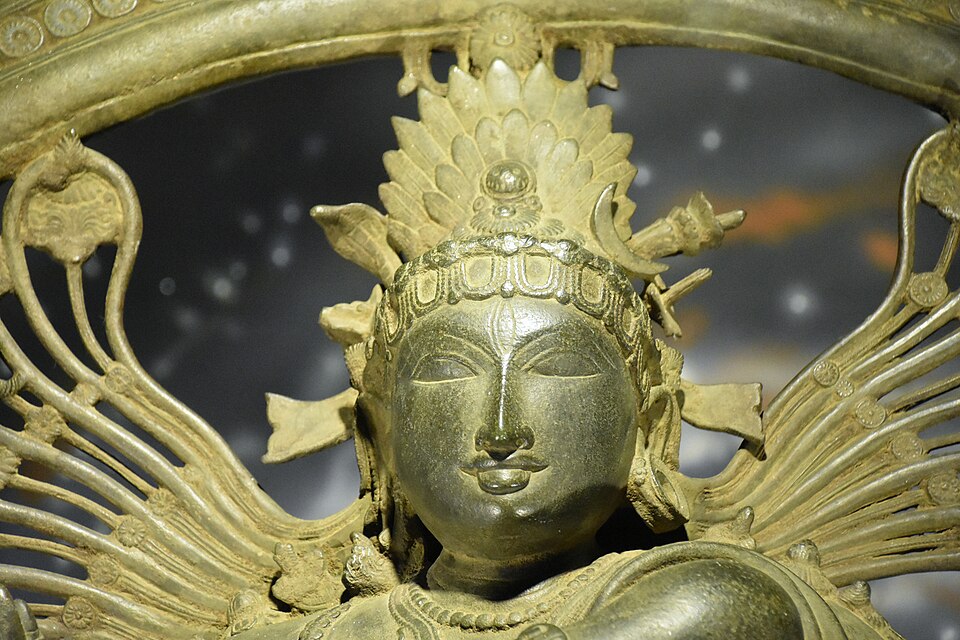
A Nataraja bronze can be approached as a sculpture, a religious image and an object with a history of ownership and use. These approaches enrich one another when they are kept clear. The aim is not to repeat a list of symbols, but to notice what a particular object can tell us.
Read the label first, then look again
A museum label may identify a date range, material, region and acquisition history. Those details concern the individual object. They should not be replaced by a general statement that all images of this type are a thousand years old.
Notice whether the object is described as bronze or more broadly as a copper alloy. Material terminology can be technical. Repeating the collection’s wording is often wiser than assigning a composition from appearance alone.
Look at spaces as well as surfaces
The ring, limbs and hair create openings that are part of the composition. Move to a different angle if the display allows it. The relationship between balance and motion becomes easier to see when the sculpture is not treated as a flat emblem.
Then examine the base and the points where elements connect. These details remind us that a complex religious idea also had to become a stable physical object. Artistic interpretation and practical making are connected.
Worship and museum display are different settings
Some South Indian sacred images have roles in procession and worship. A museum display presents an object under different conditions. It may allow close visual study while leaving much of the original sensory and ritual context outside the case.
Do not invent a specific processional history for an individual sculpture without evidence. Instead, distinguish the general tradition from what is known about that object. The same care should apply to provenance: a gap in ownership history should not be filled with a confident story.
Photograph and share responsibly
Check the collection’s image policy. A museum photograph may carry a different rights statement from the object itself. When using an image, retain the artist or photographer credit where required and link to the collection record or file page.
After looking, describe three visible features before offering an interpretation. This simple order helps separate observation from assumption. The result is usually a more useful account of Chola art than an assertion that the sculpture encodes modern physics. The craftsmanship and religious imagination already provide more than enough to discuss.
Sources & further reading
www.metmuseum.org — reference and further reading. Interpretive reflections and practical reading suggestions in this article are the website’s own explanatory material. Check current official arrangements before travelling.