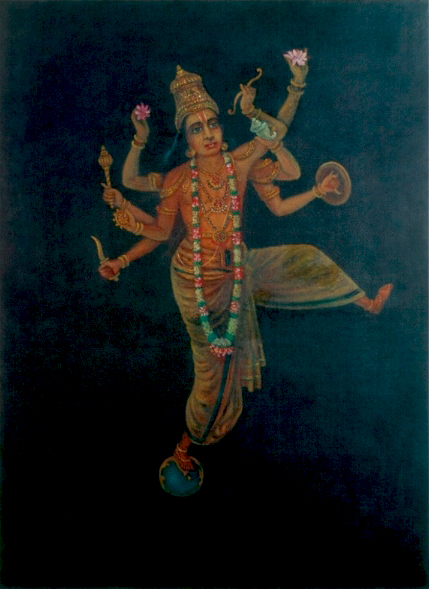
Navadurga refers to nine forms of the Goddess that are especially familiar during Navratri. Their names, images and local observances give worshippers several ways to approach divine strength and care. The sequence is important in many communities, but it should not be presented as the only form of Navratri practised across India.
Learn the names before assigning a lesson
The familiar sequence names Shailaputri, Brahmacharini, Chandraghanta, Kushmanda, Skandamata, Katyayani, Kalaratri, Mahagauri and Siddhidatri. These names occur in the Devi Kavacha tradition. Their translation and imagery provide a useful beginning: Shailaputri evokes the daughter of the mountain; Skandamata identifies the mother of Skanda.
Popular teaching often assigns a psychological lesson to each day. Such reflections can be meaningful, but they should be introduced as interpretations. A claim that every form corresponds to a scientifically established stage of mental development gives an interpretation an authority it has not earned.
Read images patiently
Look for a mount, an object held in a hand, the presence of a child or a distinctive posture. Compare those details with the caption of the image you are using. An artist may simplify, combine or adapt familiar attributes, and a damaged sculpture may not preserve everything needed for identification.
Do not assume that any photograph of a Durga temple depicts all nine forms. A directory photograph can show a building, while a devotional print can show a named group of deities. Clear captions help the reader understand which kind of illustration is on the page.
One festival, several arrangements
Some households follow a day-by-day Navadurga sequence. Other settings emphasise Durga Puja, a display of dolls, community dance, recitation or the worship of particular local forms. These are not shortcomings in an otherwise uniform festival. They reflect the variety of communities that give the nine nights their meaning.
Even a familiar calendar can require local clarification. Lunar dates do not always produce an identical sequence of civil dates in every place. Ask the temple or household whose observance you intend to join rather than relying on an undated social-media timetable.
Participate through attention
Learn a name, listen to a song and ask about the practice of the people hosting you. If helping at an event, ordinary tasks such as arranging seating or clearing a shared meal are part of participation too. A thoughtful account of Navadurga leaves room for devotion, art and community without promising that nine prescribed steps will automatically transform every person's life.



