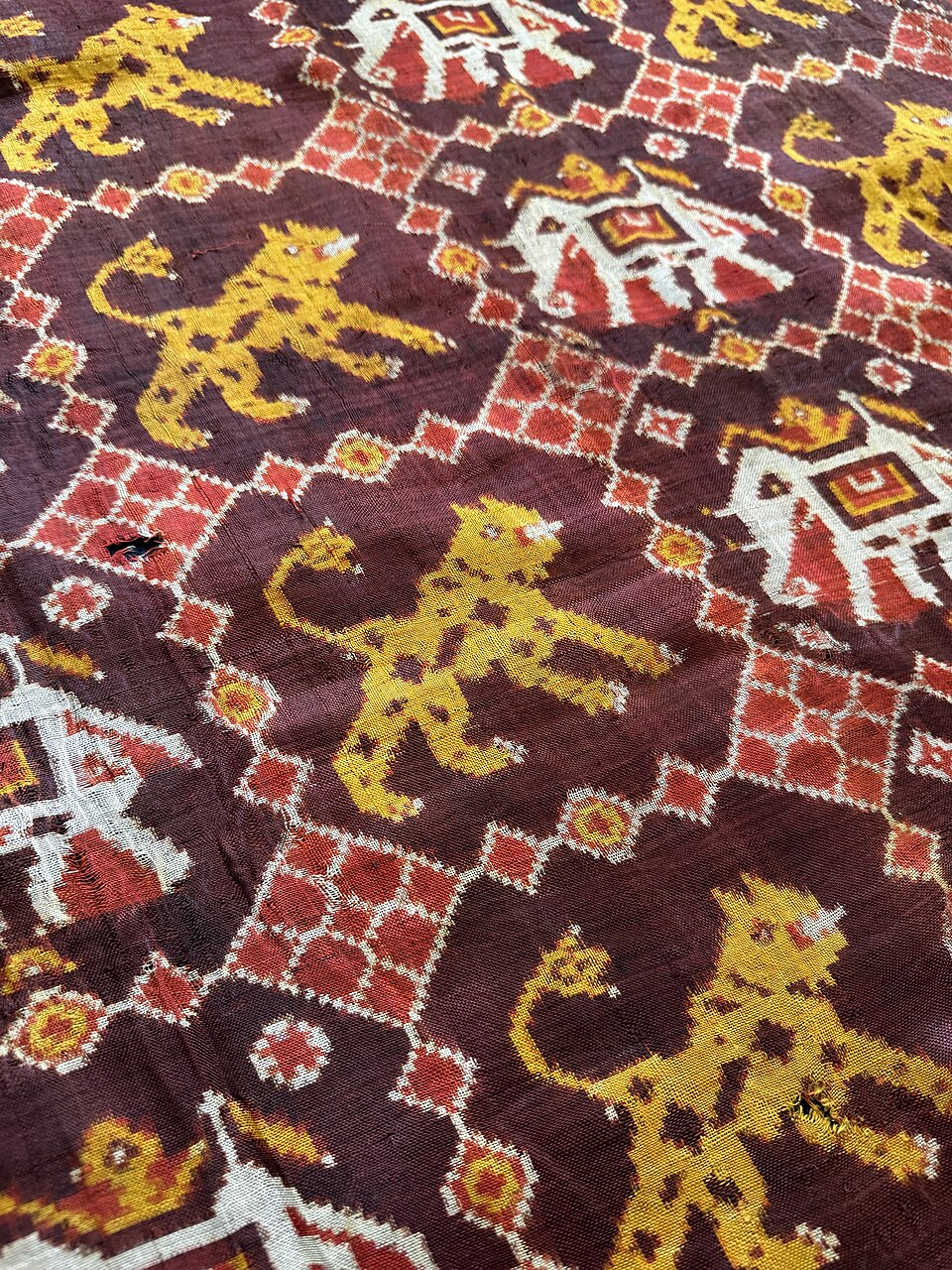
With Patan Patola, the most useful question is not only how the design is woven. It is how the design begins before weaving. In double ikat, both sets of threads are prepared with colour patterns that must meet correctly on the loom. The cloth’s visual clarity depends on decisions made well before the finished motif can be seen as a whole.
Understand warp and weft
The warp runs along the loom, while the weft is passed across it. In Patan’s double-ikat tradition, both are resist-dyed in planned sections before weaving. Their alignment creates the design. That is different from applying a pattern to a cloth after it has been woven.
A demonstration using a small sample can make this much clearer than an elaborate verbal explanation. Ask to see how a partly woven motif relates to the threads awaiting the next passes. Observe without touching the tensioned threads or interrupting the work.
Distinguish related textile names
Gujarat also has single-ikat weaving traditions. Similar-looking designs do not mean identical technique, origin or labour. Ask whether the textile is double ikat, single ikat, printed or another kind of production, and request an accurate description on the purchase record.
This is not a reason to dismiss one process as worthless. It is a reason to compare like with like. A buyer should be able to appreciate a less expensive textile without being told that it was made by a different and more demanding process.
Look for the logic of the repeat
Choose one motif and follow where it meets the next. Notice how colour boundaries and repeated shapes organise the field. A close look can reveal the visual challenge of aligning two sets of patterned threads.
Do not rely on a single popular “test” to authenticate an expensive piece. Photographs, reverse-side appearance or an isolated irregularity cannot replace clear provenance and a credible explanation from the maker or seller. Keep technique and origin documented.
Learn before choosing
A workshop or museum visit can be worthwhile even when no purchase is planned. Ask about the stages of preparation, the division of work and how the pattern is recorded. Avoid repeating one fixed production time as if every size and design requires exactly the same labour.
If buying, discuss care, storage and the intended use of the cloth. Retain the maker’s details and description with it. Patola is more interesting when its value can be explained through the coordination of design, dyeing and weaving, rather than only through a high price or a claim of rarity.
Sources & further reading
Official cultural reference — background and further reading