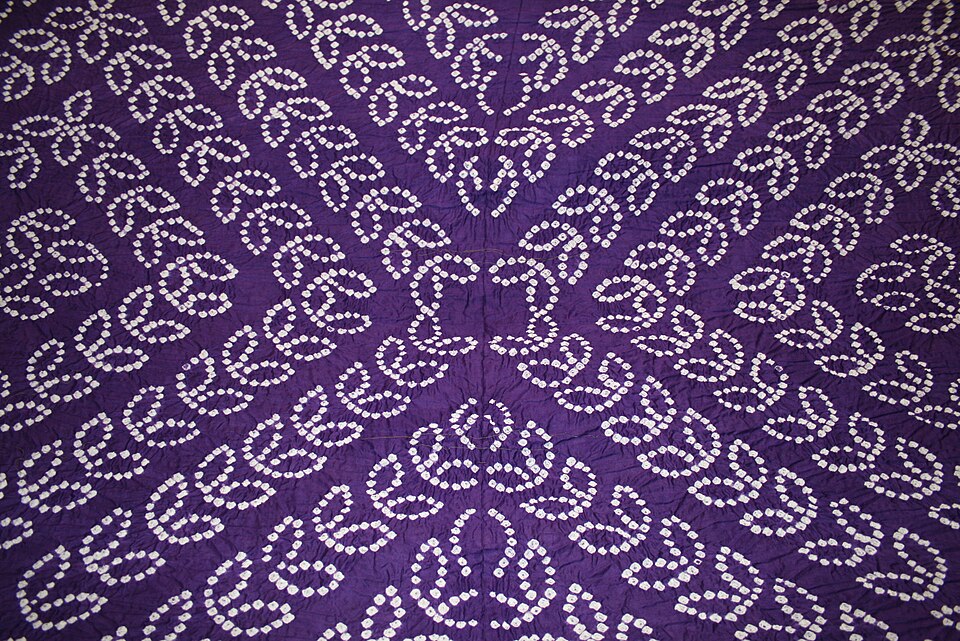
From a distance, Bandhani may look like a field of bright dots. Up close, those dots point towards a sequence of tying and dyeing. The pattern is created partly by preventing colour from reaching selected areas of cloth. That simple principle produces a wide range of effects, but the labour behind the small repeated marks is easy to underestimate.
Understand the resist
Bandhani belongs to tie-dye traditions associated especially with Gujarat and Rajasthan. Small portions of fabric are tied so that they resist dye. The arrangement of those tied areas helps determine the design that appears when the cloth is opened.
This differs from printing a dotted pattern onto a finished surface. A printed imitation can be attractive, but it should be described accurately. Ask the seller about the process rather than assuming that dots alone establish hand tying.
Look at groups rather than single dots
Notice how the dots form larger shapes, borders or changes in density. A pattern may be understood at several distances: individual marks nearby, repeated motifs farther away and an overall colour arrangement when the garment is worn.
If you are allowed to examine a piece, handle it gently and follow the seller’s instructions. Some textiles are displayed with their tied texture still apparent. Do not pull at or flatten sections merely to satisfy curiosity about the process.
Ask about the cloth as well as the pattern
The fibre, dye process and finishing affect how a textile feels and how it should be cared for. The name Bandhani does not answer all those questions. Two pieces with similar designs can have different materials and intended uses.
Request care instructions for the actual purchase. In particular, do not assume a bright colour can be washed or soaked in any manner because the design is traditional. Clear advice from the maker or responsible seller is more useful than a universal home remedy.
Notice the work distributed through the process
Tying, dyeing and selling may involve different people. Ask how the piece reached the shop and who carried out the work where that information is available. This makes the production chain more visible without insisting that every seller must personally have made the cloth.
If photographing a demonstration, ask first and respect the worker’s pace. A line of tiny dots can represent much more time than a visitor spends admiring it. Understanding that relationship between repeated work and the finished pattern is one of the most satisfying ways to begin appreciating Bandhani.
Sources & further reading
Official cultural reference — background and further reading