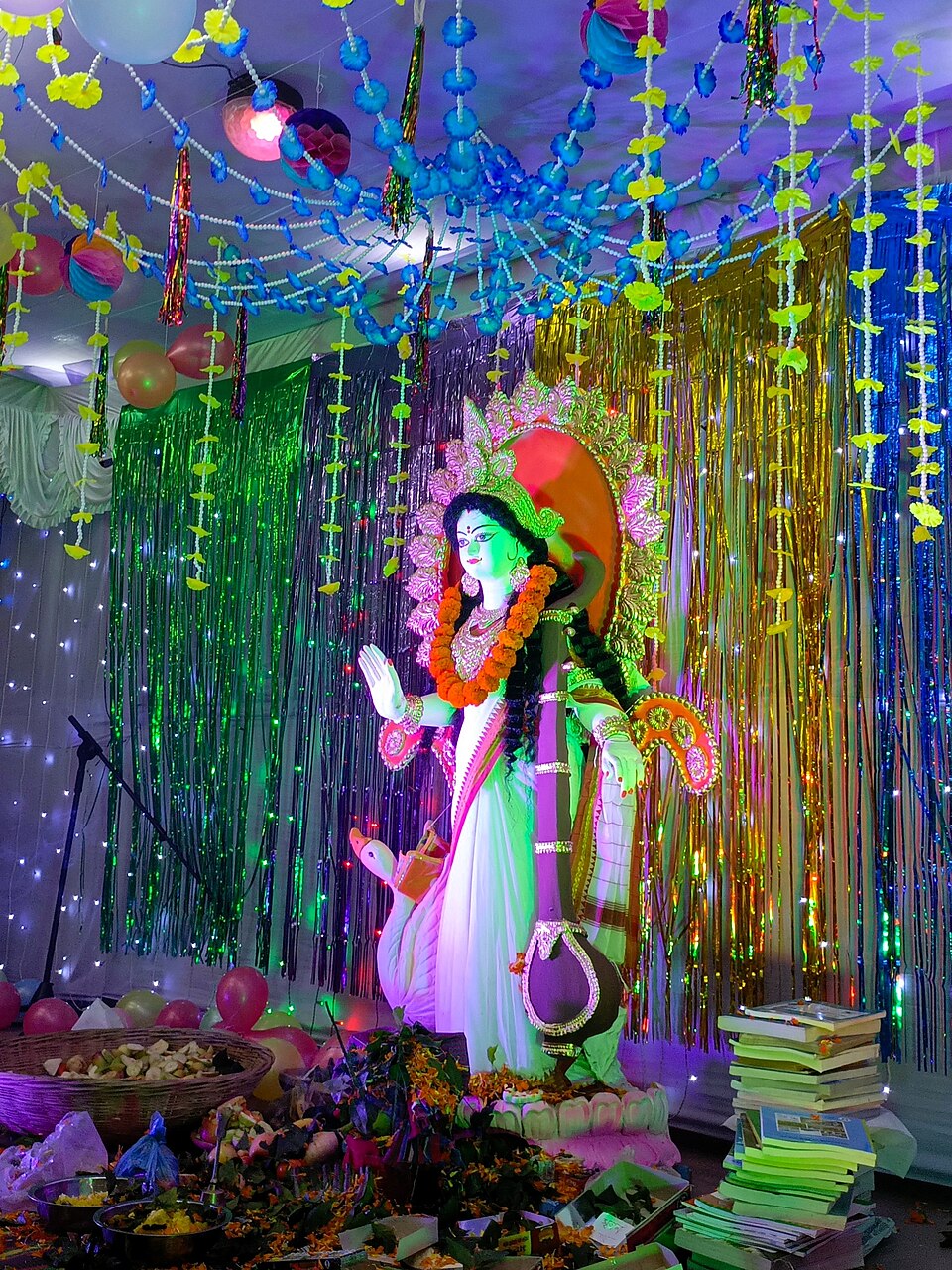
Someone familiar with Saraswati Puja at Basant Panchami may be surprised to encounter it again during Navratri. The difference reflects regional calendars and practices rather than a need to choose one celebration as the only correct form. The Goddess's association with learning can be expressed in more than one seasonal setting.
The spring association
Basant Panchami is associated with the coming of spring and, in many communities, the worship of Saraswati. Schools, neighbourhood groups and households may organise their own observances. Their scale and visual customs vary.
A photograph from one city should not be used to claim that every region follows the same dress, menu or sequence. Local practices give the celebration much of its character.
The autumn association
In Kerala's Navratri tradition, the concluding days place particular emphasis on Saraswati worship, learning materials and the beginning of education. Books and instruments may be set aside and taken up again, while Vijayadashami is associated with Vidyarambham.
This connects the festival with a rhythm of preparation, reverence and return to practice. It is a different setting from a spring celebration, even though the devotion to learning provides a shared thread.
Names do not supply a complete calendar
Neither celebration should be assigned a fixed civil date for every year. Lunar-calendar observances move within the civil calendar, and local timing conventions matter. Use the current announcement of the temple, school or household tradition being followed.
When making a family calendar, write the event's name and the source used for its date. That small habit prevents last year's poster from becoming this year's accidental schedule.
What remains common
Both settings can encourage gratitude for teachers, care for books and instruments, and a fresh commitment to learning. Those values do not require identical decorations or identical recitations.
If a family has connections with more than one region, children can learn why relatives celebrate differently. Ask each person to explain one custom they remember rather than searching immediately for a single rule. The comparison becomes an introduction to the diversity of Indian religious life, held together by a recognisable concern for knowledge and the arts.



