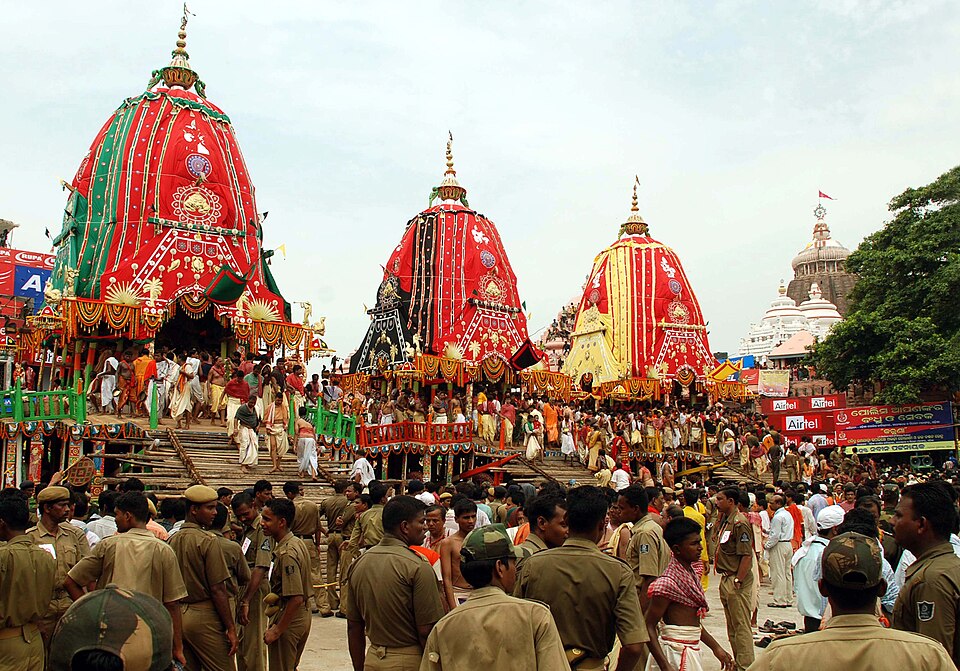
During Rath Yatra at Puri, Jagannath, Balabhadra and Subhadra travel in chariots through the town. The public journey makes a movement between sacred places visible on a large scale. Its meaning becomes clearer when the procession is understood as part of a longer cycle of preparation and return.
Look beyond the day of pulling
Chariot construction brings together skilled makers and inherited working traditions. Timber, wheels, structural members and textiles become a temporary vehicle through organised labour. Photographs of construction can explain this aspect more clearly than a distant view of the finished crowd.
Do not infer dimensions or technical methods from a single image. Use the temple's or an official cultural source's explanation where available. A craftsperson's name and role, recorded with permission, may add more value than an unsupported claim about how quickly the work was completed.
A journey with a destination
The chariots travel toward Gundicha Temple, with a return journey later in the observance. The three deities and their distinct vehicles are central to understanding the scene. A broad photograph may show all the chariots, while a close crop can make it difficult to tell which is represented.
Caption accordingly. If the image does not establish the identity of an individual chariot, describe the procession generally rather than guessing from a partially visible colour. The site, year and source are useful details in their own right.
Public worship and shared space
The festival is often discussed in terms of the deities coming into public view. That does not mean every visitor should try to reach the same point in the crowd. A thoughtful visit takes personal mobility, heat, companions and the possibility of long waits into account.
Follow current official routes and instructions. Arrange a meeting point and a way to contact companions. A cultural introduction can explain the journey's significance but cannot guarantee access or predict the conditions at a particular hour.
Notice service as well as spectacle
The ceremonial sweeping of the chariots is one prominent ritual with a message of service. Alongside it are many ordinary tasks that keep a gathering functioning. Looking for those tasks broadens the story beyond the motion of wheels and ropes.
For a record of the festival, pair a wide scene with a detail of making or preparation, clearly dated. The combination tells a fuller story: the chariots do not simply appear on a road, and the public moment depends on a much longer sequence of knowledge, work and care.



